
Do not climb or reach into the gutter to measure water for this guide. Use safely available observations, existing photographs and an assessment. The goal is to understand the explanation behind a recommendation, not to set a universal acceptable water depth or carry out a roof-edge test.
Describe Where and When Water Remains
Identify the affected run and where the water appears relative to a corner or outlet. Note the timing you actually know: during rain, after rain or in an existing assessment photograph. If the view does not show the whole run, record that limit.
A photo taken at an angle may show a reflection without establishing the depth, direction of fall or outlet condition. Likewise, an image with no visible water does not prove that the route was assessed under relevant conditions. Ask what was observed rather than read more into the picture than it shows.
Keep the date and any known recent cleaning or repair with the record. “Water remains near the middle of the porch run after the reported cleaning” is more useful than “the gutter is bad.”
Separate Overall Fall From a Local Low Spot
Overall fall describes the change in elevation along a run toward its outlet. A localized low spot is a separate geometry question and may retain water despite an overall fall toward the outlet. A run can require review of both, so a general statement that it “slopes to the downspout” may not explain an isolated pocket.
The Standard Work Specifications gutter detail identifies drainage toward downspouts as a slope objective. PNNL's gutter guidance also connects gutter geometry with the onward route. Their published specifications have different contexts; neither is a remote inspection or an automatic Atlanta acceptance rule.
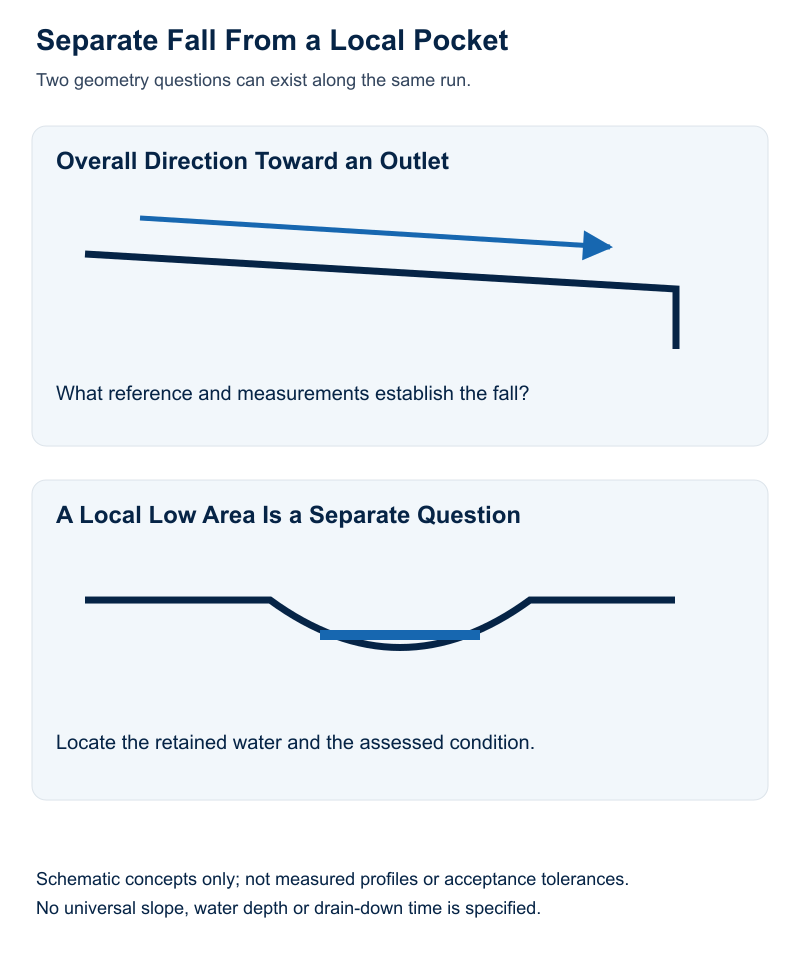
Ask what reference and measurements support the recommendation. The roof edge, fascia trim or a photograph may not be a reliable level reference. There is no do-it-yourself leveling procedure or universal residual-water tolerance in this guide.
Consider the Outlet as a Separate Transition
Water must leave the channel through the outlet arrangement. Its location, condition and connection are separate from the appearance of the gutter's front edge. A recommendation to change the run should explain how the affected area relates to the outlet.
If water remains near an outlet, identify whether debris, the local geometry or a downstream concern has actually been assessed. Do not treat every instance as proof that the whole run needs resetting. If the connected route is uncertain, our downspout boundary guide helps organize that question.
A larger nominal gutter is also not a complete answer to retained water. Size, profile, outlet and downspout need to be considered together. The gutter sizing guide explains that broader design decision.
Distinguish Cleaning Findings From Geometry Findings
Debris can be relevant to a water-retention concern, but a cleaning description should identify the areas actually reached and any remaining limitation. UGA's Home Maintenance Checklist includes gutters and downspouts in its evaluations; it does not establish that cleaning resolves every gutter condition.
After cleaning, a report may distinguish removed material from a remaining low area, damaged component or unresolved outlet question. That distinction makes a subsequent repair proposal more useful.
If the same symptom continues, compare the earlier work with the new finding. Avoid repeating the same task solely because it is familiar, and avoid assuming the earlier task was done incorrectly merely because another condition remains. Different work can address different parts of the route.
Review Support and Channel Condition
An assessment of the geometry may need to consider the channel and the parts supporting it. A local dip, a shifted attachment and a deformed section are different findings. The proposed change should identify which one was established.
If hardware or adjoining support material is involved, clarify the scope before treating the issue as a simple adjustment. A statement such as “reset the gutter” should name the affected area, retained components and any conditions that remain concealed.
Our sagging gutter guide focuses on the support chain. This article stays with the water and geometry questions, so the two records can be used together without assuming every retained-water concern is a support failure.
A Worked Example: Water Away From the Downspout
Imagine a photograph shows water near the middle of a straight porch run, with a downspout at one end. The following are three different levels of evidence in a hypothetical record; they are not findings about a customer’s home.
1. The photograph: “Water is visible near the middle of the porch run.” Keep the date, view and known timing. The image locates the concern but does not measure the channel profile, establish the outlet condition or explain the cause.
2. The assessment finding: If the assessor reports a local low area, the record should identify the affected part, the reference used and the measurements or observations supporting that conclusion. Keep any separate outlet restriction or inaccessible connection in its own finding. A general note that the run “falls toward the outlet” does not describe the intervening profile.
3. The work and follow-up: A proposal might address the confirmed local geometry while retaining specified parts. The completion record should then identify what changed and what was actually checked afterward. A dry photograph, by itself, does not establish which work was done or under what conditions the result was reviewed.
These entries serve different purposes: locate the concern, explain the finding and record the response. If the original concern was water spilling over the front rather than water remaining afterward, return to the overflow-after-cleaning guide so the proposed work answers the right symptom. No universal depth, slope or drain-down tolerance is inferred from this example.
Read a Recommendation With This Matrix
| Recorded Condition | Question the Assessment Should Answer | Detail to Carry Into the Work |
|---|---|---|
| Water appears in a localized area | What establishes the local geometry and relevant timing? | Exact area and proposed change |
| Material remains in the route | Which parts are accessible and included in clearing? | Areas reached and unresolved restrictions |
| Concern is close to an outlet | What is known about the transition and connection? | Outlet work versus separate downstream assessment |
| Channel or supports are damaged | Which components need attention? | Parts replaced, retained and unassessed |
| Evidence is incomplete | What can be established next? | Assessment limit rather than a presumed result |
These are explanations to seek, not diagnoses generated from a table. The right proposal depends on the findings at the actual property.
Keep the Final Record About Outcomes
Record what was done and what was observed afterward. “Adjusted the affected section” describes work. Any report about the result should separately say what was checked, under what conditions and with what limitations.
Do not assume a brief observation establishes performance in every future storm. Equally, do not substitute a photograph of a dry gutter for a description of the assessment. Keep the report proportionate to what was actually established.
If the findings change the planned work, clarify that change and its price before agreeing. The FTC's written-estimate guidance supports keeping work descriptions and cost promises together; it does not prescribe the geometry of a gutter.
Common Questions About Water Remaining in Gutters
Does Every Visible Puddle Mean the Gutter Must Be Replaced?
No conclusion follows from the observation alone. Establish the location, timing, geometry and route before deciding the work.
Is There One Acceptable Depth or Drain-Down Time for Every Gutter?
This guide does not set one. Use the actual system requirements, relevant project specifications and assessment rather than a universal number from a website.
Can Cleaning Correct the Slope?
Cleaning and geometry work are different tasks. Confirm which finding each proposed task addresses rather than assume one includes the other.
Should I Fill the Gutter With Water to Test It?
No homeowner test procedure is provided here. Discuss appropriate assessment and access without climbing, loading or altering the gutter yourself.
Explain the Location Before Choosing the Repair
For gutter repair, describe where water remains and any previous work. If a new system is being considered, use the installation service information to understand the wider layout decisions.
Sources and Review Method
Sources checked October 26, 2026. This document-based guide explains observation, geometry and assessment boundaries. It adopts no universal slope, retained-water tolerance, code requirement or company test procedure. The diagram, hypothetical example and recommendation matrix are original editorial aids.