
Ask where each downspout leads, what is known about that route and where water can go after reaching its destination, including during overflow. A visible pipe or extension is only part of the picture.
Separate the Route From the Destination
These terms describe different parts of a system. They are not three mutually exclusive choices.
| Term | What it describes | What it does not establish |
|---|---|---|
| Above-ground extension | A visible component carrying water onward from the downspout | Whether the receiving location is suitable or water can flow back toward the home |
| Buried conveyance | A pipe transporting water below ground | Its condition, exact route, receiving destination or permission to use that connection |
| Daylight outlet | An exposed point where a drainage route discharges | That the entire route is above ground, or that everything beyond the outlet has been assessed |
A buried pipe can end at a daylight outlet. It might instead lead to a different receiving system, but that destination needs to be established rather than assumed from the visible connection.
PNNL describes roof-water routes to daylight and other receiving systems. It warns against connecting a gutter drain to a perforated foundation drain. That distinction is why an existing buried pipe should be identified rather than treated as an interchangeable “French drain.” PNNL gutters and downspouts guidance.
Sketch Five Things Before Comparing Options
A useful route sketch can be simple. Label the parts you can identify and leave unknowns visibly unanswered:
- Collection: Which roof section and gutter feed this outlet?
- Downspout: Where does the vertical section reach the ground or connection?
- Conveyance: What carries water onward, above or below ground?
- Receiving point: Where does that route end or join a receiving system?
- Path beyond: Where can water go after discharge, including during overflow?
Ask how the route was established. A visible outlet, an existing plan and a professional investigation are different kinds of evidence. If the destination remains unknown, the proposal should say so and explain what investigation is included before relying on it.
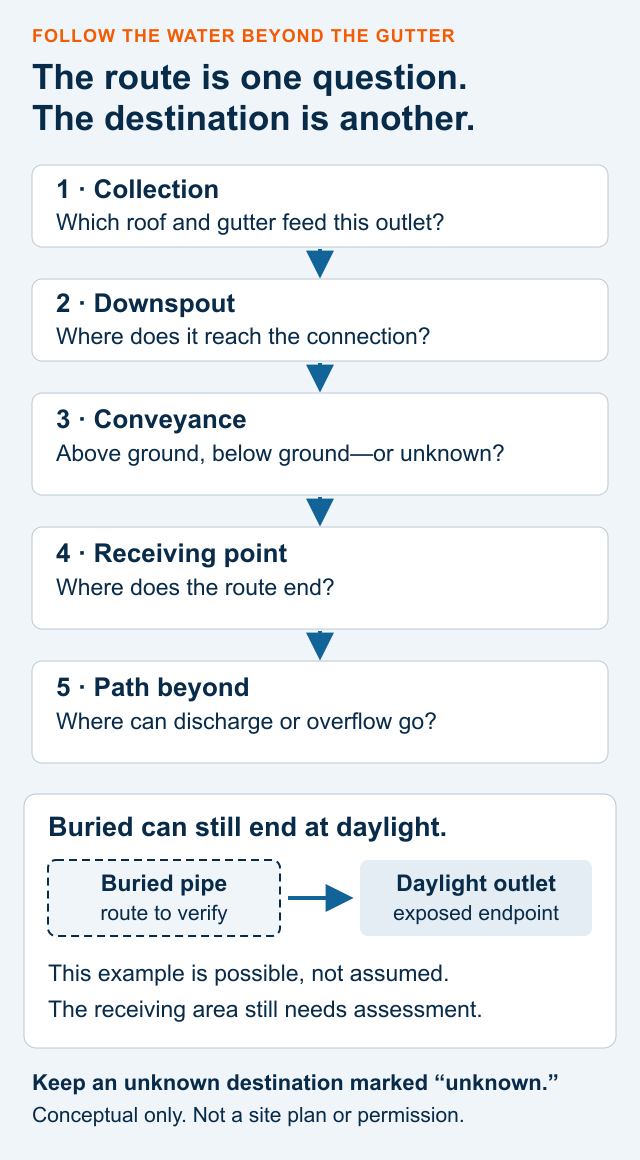
Original conceptual route map, not a construction detail. Arrows show relationships, not recommended slopes, distances, pipe sizes or approved destinations. An unknown connection stays unknown until assessed.
Evaluate What Happens After an Above-Ground Extension
An extension can make part of the route easy to see. The comparison still needs to include what happens where it ends. Ask about the ground beyond the outlet, any route back toward the building, and nearby steps, walkways or other affected areas.
Record observations rather than trying to redesign the route yourself. Does the end remain in its intended position? Is there a visible obstruction? Does water collect near the outlet or continue somewhere else? Note whether a concern appeared after landscaping or other changes. An observation helps define the question; it does not by itself establish the cause or a suitable repair.
Portland's stormwater maintenance guidance discusses gutter and downspout condition, extensions, the receiving ground and connected standpipes. Those are useful categories for an assessment. Its local distances, connection rules and maintenance instructions are not adopted here as Atlanta requirements. Portland stormwater maintenance guidance.
If a proposal simply adds length, ask what finding supports the new termination point. Moving the outlet farther along the same unsuitable route is not an explanation of how the receiving conditions have been addressed.
Treat Buried Connections as Something to Verify
For an existing buried route, ask which parts have actually been identified. The downspout connection is only one end of the question.
Useful questions include:
- Where is the receiving point, and what evidence identifies it?
- What is known about the route and condition of the retained pipe?
- Which sections or connections remain unassessed?
- Where is maintenance access, and what access work is included?
- If water cannot follow the intended route, where could it appear or go next?
Portland's guidance specifically identifies clogged standpipes and loose or cracked connections as maintenance concerns. It does not supply a diagnosis for an unseen pipe at your home. A proposal should distinguish a known defect from a connection that has not yet been investigated. Portland connected-pipe maintenance guidance.
Do not dig, dismantle connections or enter drainage structures to complete this article's checklist. Ask what investigation is appropriate, who will perform it, and what approvals or utility-location steps must be addressed before any excavation. This guide provides no excavation or connection procedure.
Why Discharge-Distance Advice Differs
Online numbers can refer to different systems and purposes. UGA's Home Maintenance Checklist gives a general discharge-away-from-the-home note within a broad maintenance checklist. PNNL's drainage guide includes different arrangements and distances in federal program and building-practice contexts. They are not interchangeable instructions for every Atlanta property. UGA Circular1082, PNNL drainage guide.
| Source context—not a distance selected for your home | What the source says |
|---|---|
| UGA's general home-maintenance checklist | Its gutter/downspout entry mentions discharge 2–3 feet from the house. |
| PNNL's guide and cited program context | It describes sloping-grade discharge at least 5 feet from the foundation or an underground catchment at least 10 feet away. |
The different arrangements and purposes matter. This comparison reports the sources; it does not establish that any one of these distances is sufficient or permitted at your property.
Rather than selecting a number from a search result, ask how the proposed receiving point was chosen. The explanation should address the actual property, the receiving conditions, the complete route and any applicable requirements. This guide does not establish a universal setback or determine current local permission for a particular outlet or connection.
Distance is one detail to clarify. It does not replace understanding where the water goes after it reaches that point.
A Receiving Area Needs More Than a Label
“Into the yard” leaves important details unanswered. Which area? What is its relationship to the building, the water route and neighboring property? What evidence supports its suitability?
EPA's general downspout-redirection page discusses directing water toward receiving areas such as a lawn or garden, but also cautions that disconnection is not appropriate everywhere and that local rules and potential damage matter. The page explicitly says it is no longer being updated; its footer date does not make it current local authorization. EPA downspout-redirection overview.
Ask for the receiving area to be identified on the proposal or sketch. Do not assume a pipe may be disconnected from an existing system or connected to a street, sewer or other drain. Those are site-specific questions to verify with the appropriate authority and qualified people involved in the work. A website illustration cannot establish permission.
Is a Rain Garden the Same as a Wet Patch?
A rain garden is a planned receiving feature, not simply a name for an area where water already collects. UGA Forsyth's rain-garden guidance considers soil drainage, landscape slope and the area contributing runoff. Those factors explain why suitability needs assessment. Its 2020 weather outlook and numerical construction details are not used here. UGA Forsyth rain-garden guidance.
This article does not recommend a rain garden, drywell, rain barrel or other landscape feature for your property. Naming these possibilities also does not mean Atlanta Gutter Specialist offers their design or installation. Confirm the scope and any additional expertise needed before assuming the gutter project includes that work.
Ask About Overflow and Future Access
Ask what happens if the receiving system cannot accept water at that time. Where is the intended overflow route? Could an obstruction or altered outlet change it? Which part of that question has been assessed, and which remains outside the proposal?
PNNL discusses overflow and cleaning access for catchment systems. Those are questions to resolve, not homeowner construction instructions. PNNL catchment-system guidance.
Maintenance access should also be understandable after the work is complete. Ask which connections or access points will remain visible, who can service them, and what instructions apply to the actual installed arrangement. An attractive finished appearance does not explain how an inaccessible route will be investigated later.
Record the Visible Downspout Route Safely
Use the downspout route observation checklist to record what is visible from a safe ground-level position:
- The side of the home and the downspout being discussed.
- The visible extension or connection.
- The known receiving point—or “unknown.”
- What you noticed before, during or after rain, only if it was safe to observe.
- Any related work or changed landscaping you know about.
- The questions the proposal still needs to answer.
A photograph of the connection and a wider view of the surrounding area can help explain the concern. Do not climb to obtain a roof view or approach overhead wires. CPSC warns that ladders used near overhead electrical lines can create an electrocution hazard, including during gutter work. CPSC ladder and electricity warning.
Visible pooling belongs in the notes, but it does not by itself prove that a gutter is undersized or that a particular buried pipe has failed. Keep observations separate from the explanation that still needs assessment. The overflow guide addresses roof-edge symptoms; the gutter sizing guide explains the collection-system questions.
Compare the Drainage Portion of the Proposed Work
The FTC recommends comparing written estimates that describe the work, materials, completion date and price. For a drainage conversation, use that advice to make the boundaries clear. This is general consumer guidance, not a legal checklist or technical design approval. FTC home-improvement guidance.
Ask the proposal to identify retained connections, investigation, new conveyance, the receiving point, any receiving-area work, final checks and exclusions. Clarify who is responsible for assessing the destination and verifying applicable requirements. If additional drainage or landscape work is outside the gutter scope, record that distinction before deciding.
For gutter-related concerns, explore gutter repair or installation and replacement, then contact Atlanta Gutter Specialist to discuss the water route at your home. Start with what you have observed and what is still unknown.
Sources and Editorial Method
Sources checked October 25, 2026. This guide uses primary federal, university-extension, municipal, safety and consumer information. The route map, observation prompts and comparison questions are original editorial tools; they do not diagnose a property or authorize drainage work.
UGA Circular1082 was fully reviewed March1,2023; the Forsyth rain-garden article is dated July1,2020. EPA's redirection page explicitly is no longer updated despite its October13,2026 footer. Regional and program-specific distances and connection rules are not presented as current Atlanta law.