
Start with the same project description for each company. Then compare how each responds. You do not need to diagnose the problem or arrive knowing which gutter size to buy; you need to understand what the recommendation addresses and what you would be agreeing to.
Describe the Same Project to Each Company
Write a short description of the concern and location. For example: “Water crosses the front edge near the rear corner. The last cleaning date is uncertain, and I do not know where the connected downspout ends.”
Keep the description factual. Separate a visible symptom from an assumption such as “all the gutters are too small.” Include known work, relevant documents and anything you cannot see or establish. If one company receives a whole-home replacement request and another receives a request to fix one corner, their responses may answer different questions.
Ask what the next assessment would cover and what information is needed. Do not climb or dismantle anything to prepare for the call. Safely available notes and existing records can be enough to begin a useful discussion.
Verify the Business Information Behind the Proposal
Record the business name and the contact details used for the proposed work. Check that the information on the proposal is consistent with the business you intend to hire. If different names appear, ask for an explanation before treating the documents as interchangeable.
FTC home-improvement guidance recommends checking relevant credentials and requesting proof of insurance, along with researching a company's reputation. Use those as verification steps, not as facts established by a website icon. FTC Home-Improvement Consumer Guidance.
For licensing, ask which requirements apply to the actual scope and location, then verify with the relevant authority. Georgia's consumer guidance distinguishes state requirements, exemptions and local requirements; it directs uncertain consumers to the Secretary of State and city or county government. It does not establish that every gutter task requires one universal state license. Georgia Home Building and Repair Guidance.
A registration, license, insurance document and product credential answer different questions. Ask what each document establishes and whether it applies to the work being proposed. Clarify questions about a requirement or coverage with the relevant authority or provider.
Ask How the Recommendation Fits Your Home
A useful recommendation should be understandable in ordinary language. Ask the company to connect the finding with the proposed work:
- Where was the concern identified?
- Which related components were assessed?
- What is being retained, repaired or replaced?
- Why does the proposed scope address the finding?
- What remains concealed, inaccessible or otherwise unassessed?
“Replace everything” and “just clean it” are conclusions, not explanations. Either may need supporting detail before you can compare the work. Ask for a marked photograph, sketch or written description if that makes the relationship clearer. Confirm what the company can actually provide rather than assuming a particular assessment package is included.
Compare a Vague Answer With a Usable One
A useful response connects the same location, finding and proposed work. Compare these hypothetical answers; they illustrate the information to seek, not statements made by a company or evidence that an assessment has happened.
| Vague Answer | A More Useful Response Identifies |
|---|---|
| “The whole system is bad.” | The affected runs, the established condition and why the proposed extent of replacement follows from it. |
| “We will reseal the corner.” | The confirmed escape point, physical connection condition, preparation and components being retained or changed. |
| “Cleaning covers everything.” | Named gutter runs, outlet/downspout work, guard access, cleanup and any downstream limit. |
| “The old downspouts can stay.” | Which downspouts, what was assessed and how their connections fit the proposed installation. |
The longer answer is useful only when its details are supported. A marked-up photo can identify a location; it cannot stand in for a finding it does not show. Keep unanswered items open instead of giving a proposal credit for confident wording. For a maintenance quotation, use the cleaning-scope comparison to turn “everything” into named work.
For an installation recommendation, the gutter-sizing guide provides useful roof-area and outlet questions. For a repair decision, the repair-or-replace guide helps distinguish the extent of the concern from the extent of the proposed work.
Compare the Water Route, Not Just the Visible Run
Keep the roof edge, gutter, outlets, downspouts and receiving route in the conversation. Ask which of those parts are included in the assessment and proposal. An unchanged downspout connection may still have an unknown destination; a new gutter does not automatically mean every adjoining component is new.
The point is to understand the boundary of the work. One proposal may retain an existing route while another changes it. Ask why, and what each option leaves unresolved. The downspout-discharge guide explains the distinction between a visible connection and an established receiving destination.
Do not interpret a broader scope as automatically better. It needs a clear reason, just as a narrower scope needs clear limits. A useful comparison makes the differences visible without asking you to become the designer.
Use Evidence Without Treating It as a Guarantee
References, photographs and reviews can inform a decision, but ask what they actually show. Are photographs identified as that company's work, or are they stock or illustrative? Does a reference concern similar work? Is a review about the same business and the relevant service?
FTC guidance recommends reading reviews critically. A high rating or persuasive story is not a substitute for understanding your own proposal. You can ask follow-up questions while recognizing that an individual account does not establish every customer's outcome.
If you request references, respect the other customer's privacy and permission. Do not enter a property or assume that an online image authorizes a visit.
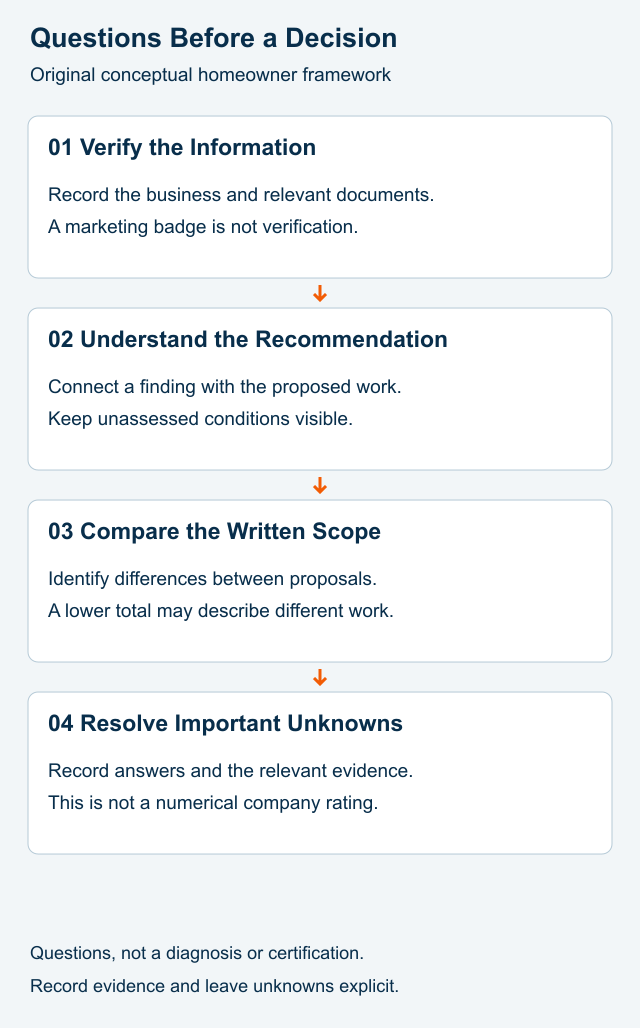
Original decision framework. These questions organize a comparison; they are not a company certification, numerical rating or guarantee of an outcome.
Put the Scope and Promises in Writing
Georgia's consumer guidance recommends obtaining estimates for identical specifications and recording promises, terms and timing in writing. FTC guidance also recommends written estimates and asking why materially different estimates differ. These are consumer comparison principles, not a legal interpretation of a particular document.
Before choosing, ask the company to make these items understandable:
| Comparison Item | Question to Resolve |
|---|---|
| Components and areas | Which runs, outlets and connected parts are included? |
| Existing materials | What remains, and how does new work fit it? |
| Related work | Are roof-edge or supporting-surface tasks included or separate? |
| Access and cleanup | What arrangements and tasks are actually included? |
| Unknown conditions | How will findings and proposed changes be discussed? |
| Timing | What is agreed, conditional or still to be established? |
| Final review | What will be checked, recorded and left outside the scope? |
The installation-estimate guide goes deeper into scope and price-basis comparisons. Keep this company-selection discussion focused on whether you can understand and verify the proposal.
Read Product and Workmanship Terms Separately
Ask for the actual terms that apply to the proposed materials and work. Identify who provides each promise, which components it concerns, any stated conditions and the process for raising a concern. Do not fill in an omitted term from a general marketing headline.
A product statement and a workmanship statement may cover different things. Ask how retained components, related work and maintenance are treated in the actual documents. Ask which product and workmanship terms apply to the work being proposed.
If wording is unclear or affects a significant decision, seek clarification from the responsible provider or appropriate professional. This article does not interpret contracts or establish cancellation, deposit, payment or dispute rights.
Keep a Record of Answers and Unresolved Questions
Record each answer, the document supporting it and any question still unresolved. This makes it easier to compare what companies have actually proposed and identify the details you need before deciding.
Open the Company-Selection Worksheet, or start with three columns:
| Question | Company A / Company B Evidence | What Still Needs Clarification |
|---|---|---|
| Who is proposing the work? | Business and contact information | Names or documents that do not match |
| What supports the recommendation? | Recorded finding and proposed response | Assessed versus assumed condition |
| What is included? | Written areas, components and exclusions | Missing or conflicting scope |
| What happens if conditions differ? | Agreed process for additional work | Decision and communication responsibility |
| What follows completion? | Actual review and applicable terms | Outstanding question and contact |
Do not add up these rows as a technical score or use them as proof that a company will perform well. Their value is exposing the questions you would otherwise carry into the agreement unanswered.
Leave Time to Resolve Important Differences
Pressure for an immediate decision is one of the tactics identified in FTC home-improvement guidance. If you do not understand a proposal, request time to read it and clarify the differences rather than replacing missing information with urgency.
A company recommending a different scope should be able to explain what it is offering; that does not require identical recommendations from everyone. Compare the basis, included work and limits. Avoid choosing solely because one total is lower or one promise sounds more complete.
Keep copies of the documents and the answers that matter to your decision. Your record should show what was actually agreed, rather than a reconstructed memory of the sales conversation.
Talk Directly About Your Gutter Project
Learn about Atlanta Gutter Specialist and our process, then contact us with your project description and the questions you want answered. For a planned replacement, start with gutter installation; for an existing localized concern, see gutter repair.
Use the same questions here that you would use when evaluating any company. The goal is a clearer conversation and an understandable scope, without requiring you to arrive with a diagnosis.
Sources and Method
Research checked October 26, 2026. FTC guidance is dated July 2022; a publication date was not verified on the Georgia consumer page. The interview questions, comparison table and diagram are original editorial tools.