
Start by comparing those details. Two proposals can both say “new gutters” while describing different outlet locations, downspouts, removal work or roof-edge preparation. A lower or higher total does not explain those differences on its own.
The FTC recommends multiple written estimates covering the work, materials, completion date and price, and asking why estimates differ substantially. That is the starting principle for this guide. The gutter-specific questions below are our comparison prompts, not a list of legally mandatory contract clauses. FTC home-improvement guidance.
Begin With the Same Project Description
Before comparing proposals, give each company the same description of the work you want to discuss. Identify the roof sections involved, any gutters or downspouts you expect to retain, the concerns you have noticed and planned exterior changes that may affect the conversation.
Choosing who prepares or carries out the work is a separate comparison. Our guide to choosing a gutter company shows how to evaluate the answers and evidence behind a proposal, alongside the scope items below.
Georgia's Attorney General consumer guidance recommends obtaining written estimates for identical project specifications and putting promises and timing in writing. That supports comparing a shared project description rather than treating every proposal heading as the same job. It does not determine the required scope or legal terms for your particular project. Georgia home-improvement consumer guidance.
Keep a short list of your priorities beside the proposals. For example: replacement on specified roof sections, a particular exterior appearance, investigation of an existing connection, or coordination with other roof-edge work. Mark which priorities each proposal actually addresses. A conversation about an item is not the same as written confirmation that it is included.
Identify the Runs, Quantities and Retained Components
Ask for a sketch, marked photograph or clear description that connects the proposed work to the home. It should be possible to tell which sides, roof levels, porches or additions the proposal refers to.
Useful quantity questions include:
- Which gutter runs are measured and included?
- What corners, returns and other connections are part of those runs?
- Which outlets and downspouts are new, changed or retained?
- Are any areas intentionally outside the proposal?
- How were quantities established, and which remain subject to confirmation?
Length is one quantity, not a complete description of the job. A proposal with the same gutter length may describe a different number of outlets, a different downspout arrangement or different retained connections. Ask for those differences to be made explicit rather than trying to price the project from a single measurement.
If the decision is still whether to repair or replace existing components, use the condition-based repair and replacement guide. This article assumes you are comparing the detail of proposed installation work.
Specify the System, Not Just the Color
Ask what material, profile, size and finish are proposed. If appearance matters, clarify how the selected finish will be identified and which visible components it applies to. Do not assume a photo or color description identifies every specification.
Record the proposed gutter and downspout details separately. Ask about any components being reused and how the new work will connect to them. If one proposal revises outlet positions and another keeps the existing arrangement, note that difference before comparing the totals.
PNNL's Building America guide considers gutters, downspouts and the route away from the home as related parts of roof-water management. That supports asking for the proposed collection and discharge arrangement together. It does not supply a project-specific size, layout or current Atlanta legal requirement for this estimate. PNNL gutters and downspouts guide.
The gutter sizing explainer covers the questions behind a size recommendation. The downspout route guide helps distinguish a visible connection from an established receiving destination.
Clarify the Roof Edge and Supporting Surfaces
Ask whether the proposal includes assessing and preparing the surfaces that will support the work. Separate known preparation from conditions that cannot yet be established.
Useful questions are:
- What roof-edge or support condition was observed?
- What preparation is included in the stated scope?
- What remains concealed or unassessed?
- If additional work becomes necessary, how will the finding, scope and price be explained before approval?
The roof-edge water path deserves its own question. GAF's drip-edge guidance describes directing water into the gutter rather than down the building face. That is a reason to clarify the interface and responsibility for related work; it is not a universal installation detail, a diagnosis or a statement that roofing work is included in a gutter price. GAF TAB-R-141.
Check the Scope and Price Basis
Use four reading labels while reviewing each proposal. They are an editorial comparison tool, not standardized contract categories:
| Label | What to record |
|---|---|
| Included | The work explicitly described as part of the proposal |
| Conditional | Work that depends on a stated condition or assumption |
| Excluded | Work explicitly identified as outside the proposal |
| Unclear | Anything whose status has not been established |
A blank line belongs in “unclear,” not automatically in “included.” If a document uses different terms, ask how those terms apply to that proposal.
Then read the price basis for each relevant item. An item may be included while its final quantity or amount still needs clarification. If the proposal uses “allowance,” “provisional” or similar wording, ask:
- What exactly does that amount cover?
- Which quantity, material or condition was assumed?
- How will the actual amount be established?
- How are differences from the stated amount handled?
- When is your approval needed, and how is the revised scope documented?
Do not assume that two companies use the same term in the same way. This guide provides no universal allowance definition, price-adjustment rule or legal interpretation of the document.
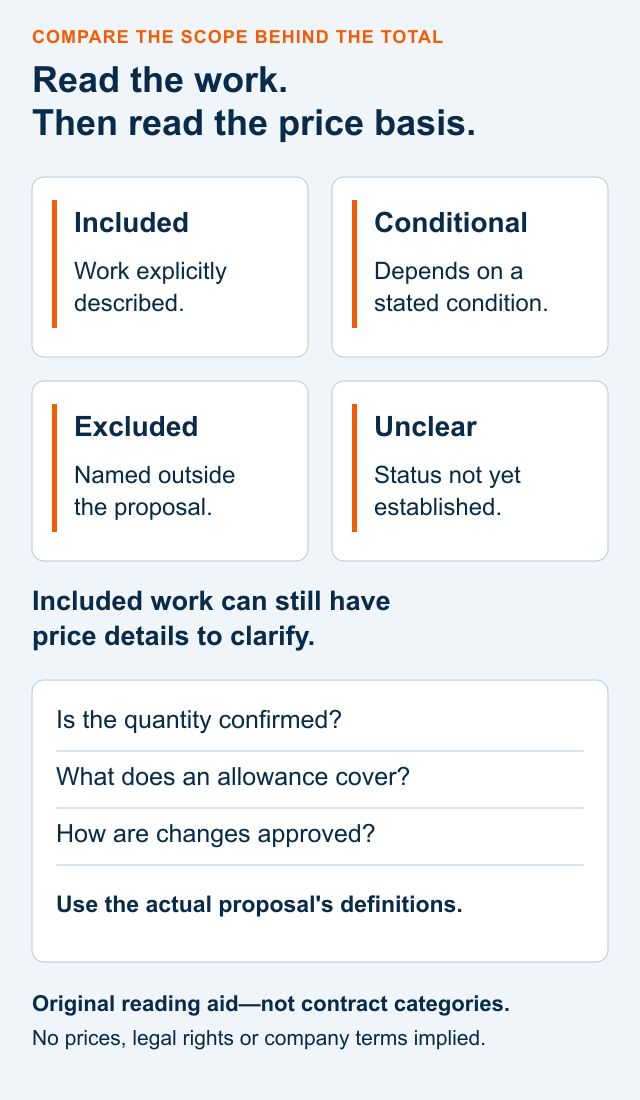
An editorial reading aid, not a contract standard. Scope status and price basis are separate questions. No prices, legal rights or company terms are illustrated.
Check the Work Around the Installation
Compare what happens before and after the new components are fitted. Ask how the proposal addresses access, removal of existing components, disposal, property protection, cleanup and final checks. Record the actual answer rather than assuming that each item accompanies the words “installation.”
If an existing downspout enters a buried pipe, clarify whether investigation or work on that connection is included. If a receiving-area or landscape change is discussed, establish who will assess it and whether it belongs to the gutter proposal or a separate scope. This list does not mean Atlanta Gutter Specialist offers every related service.
For final checks, ask what will be reviewed and how the agreed work will be confirmed. Keep the explanation specific to the actual arrangement. Do not assume a particular test, certification or performance guarantee unless the applicable written scope supports it.
List Guards and Other Optional Work Separately
If guards are offered, ask which product and attachment method are being proposed, what maintenance information is supplied, and how the option relates to the roof edge. Show whether the option is included in the total or presented separately.
GAF's gutter-cover bulletin discusses roof interfaces and manufacturer-specific warranty boundaries. It supports checking the actual product instructions and applicable terms; it does not establish that all guards void a roof warranty or that a roof warranty covers every guard-related issue. GAF TAB-R-113.
Ask separately about any product warranty and workmanship terms that apply to the proposed work. Who provides them? Which components and work do they cover? What exclusions or maintenance conditions are stated? No warranty duration or coverage from this company is assumed by this guide.
Two Hypothetical Differences Worth Noticing
Retained versus revised downspouts: Proposal A replaces the gutter runs but retains specified downspouts. Proposal B also changes outlet locations and replaces those downspouts. Even if the gutter lengths match, the scopes do not. Ask what findings explain each arrangement and what remains outside each proposal. This example does not determine which option is suitable or cheaper.
Known preparation versus an unresolved condition: One proposal describes a defined preparation item. Another leaves related work subject to assessment after removal. Compare what is known, what the stated amount covers and how additional findings will be handled. Do not turn an unresolved condition into an assumed repair quantity or an assumed final price.
Review Timing, Changes and the Document Itself
Ask what the proposed timing means and which assumptions could affect it. Keep the latest readable version of the proposal and any written clarifications together so you can tell what you are comparing.
The labels “estimate,” “quote” and “contract” do not, by themselves, explain every obligation or price condition. Read what the actual document says about acceptance, work, timing, changes and payment. Ask for clarification before agreeing to wording you do not understand. This article does not decide whether a document is binding or prescribe deposit, cancellation or other legal terms.
Georgia's consumer guidance emphasizes written promises and reviewing whether completed work matches the agreement. Use the same discipline when a proposed detail changes: make sure the current written scope reflects the decision you understand. Georgia consumer guidance.
Use a Side-by-Side Worksheet
The installation-estimate comparison worksheet gives you columns for Proposal A, Proposal B and questions to resolve. Record scope status and price basis where relevant. Keep quantities, retained components and exclusions visible; do not rank proposals using an unexplained total alone.
You can prepare by gathering existing proposals, photos you already have, your priorities and any known earlier gutter work. You do not need to supply a technical diagnosis or choose a size before starting the conversation.
Explore gutter installation and replacement, read how to plan the next steps, or contact Atlanta Gutter Specialist to discuss the proposed installation scope.
Sources and Editorial Method
Research checked October25,2026, America/New_York. This guide uses FTC and Georgia consumer comparison advice alongside PNNL system context and manufacturer roof-edge/guard information. The worksheet fields, reading labels and hypothetical examples are original editorial tools, not legally mandatory scope, technical specifications or company promises.
FTC guidance is dated July2022; a publication date was not verified on the Georgia consumer page. GAF bulletins carry revision codes RI02012021 and RI01252021.
Planning roof work at the same time? Use the roof-and-gutter coordination checklist to record retained components, roof-edge handoffs and the responsibilities in each scope.