
The useful comparison is the combination: the gutter body, its finish and profile, how the runs connect, what supports them, and where water exits. This guide separates those choices so you can read a proposal without mistaking one product label for a complete specification.
Four Choices Hidden in a Gutter Description
Imagine a proposal that says “seamless six-inch aluminum K-style gutters.” It answers four questions, but leaves others open.
| Word in the Description | What It Identifies | What It Does Not Establish |
|---|---|---|
| Aluminum | The gutter body material | Thickness, finish, compatible adjoining parts or suitability for the proposed arrangement |
| K-style | The cross-sectional profile | Every dimension, outlet detail or water-handling capacity |
| Six-inch | A nominal product size | The roof area served or the performance of the complete system |
| Seamless | The construction of a continuous run | A system without corners, ends, outlets or other connections |
A finish or color name adds another attribute. It does not replace the material specification. Likewise, a brand name is not a substitute for identifying the actual product and accessories.
Manufacturer examples make these distinctions visible. RDCA's K-style system separates material, size and finish choices. ATAS rainware includes different profiles and downspout arrangements. These examples explain product terminology; they do not establish which products Atlanta Gutter Specialist offers.
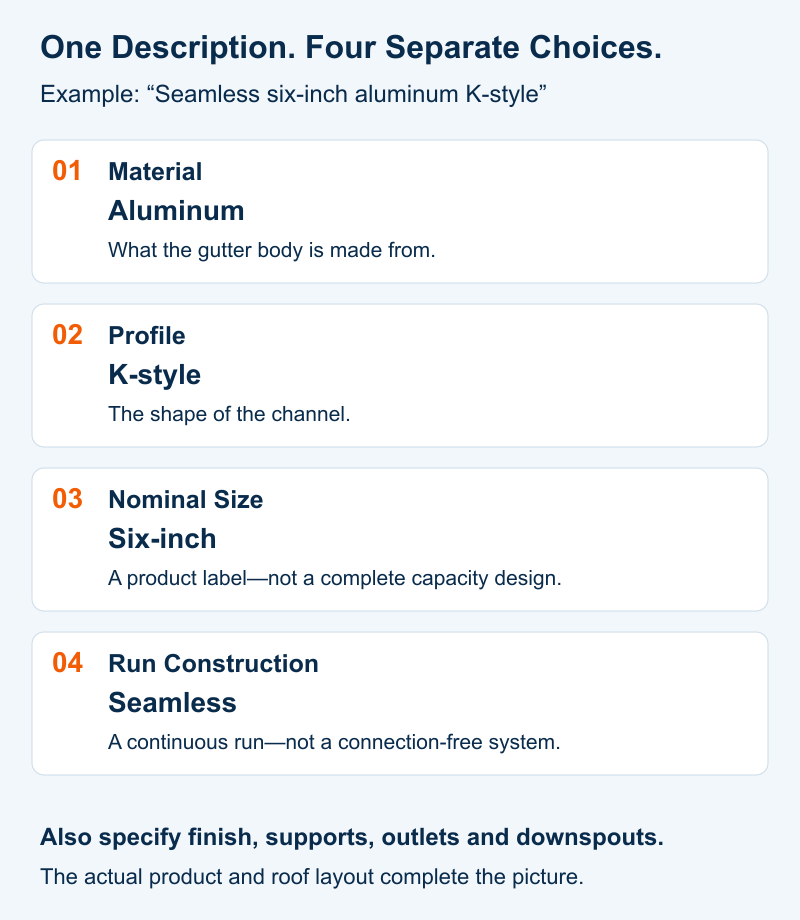
Read each attribute separately, then connect it to the complete roof drainage plan.
Gutter Materials: What Each Label Tells You
Start with the body material, then identify the specific product. A broad material category does not settle thickness, coating, fastening, joint treatment or compatibility with retained parts.
Aluminum Gutters
“Aluminum” identifies the base metal. It does not tell you whether the gutter is K-style or half-round, whether it is supplied in sections or formed as a continuous run, or what finish is proposed. K&M's K-style range illustrates how one profile family can have different material and supply options.
For an aluminum proposal, record the product or material specification, finish, profile drawing and run arrangement. If existing outlets, downspouts or supports will remain, include them in the compatibility review rather than assuming that a matching color means a matching material.
Copper Gutters
Copper is also a material choice, not a profile. A copper gutter may be described by its shape, material specification, joint arrangement and accompanying components. Berger's half-round product range is one manufacturer example showing that half-round is available in more than one metal.
When copper is part of a project, check the surrounding system as well as the new gutter body. Direct contact between materials and the route of runoff are separate compatibility questions. Our copper and aluminum gutter compatibility guide explains why retained parts and upstream materials belong in that review.
Coated Steel Gutters
A steel proposal needs more detail than the word “steel.” Record the named product, its coating or finish, and the matching components and instructions. Do not treat all coated steel systems as interchangeable, or assume a painted appearance tells you what lies underneath.
Vinyl Gutters
Vinyl is a different material family from metal. A manufacturer may supply it as a component-based sectional system with its own joiners, outlets, supports and movement provisions. Amerimax's traditional vinyl instructions provide one concrete example.
For a closer comparison of actual connectors, supports and movement provisions, read the aluminum-versus-vinyl assembly comparison. It keeps the product arrangement separate from the material label.
Read the instructions for the actual system being proposed. A detail from one vinyl product is not a universal installation rule, and a general material guide cannot establish whether that product suits your roof or project. Compare the complete product arrangement instead of assuming every vinyl system has the same joints or attachment requirements.
K-Style, Half-Round and Box Gutters Describe Profiles
A profile is the shape of the channel viewed in cross-section. Material and profile are separate decisions: the same family of shapes can be made in different materials.
K-style has a shaped front face rather than a simple semicircular channel. Half-round describes a rounded channel profile. Box describes a broadly rectangular family; the label alone does not tell you whether the proposed arrangement is an external attached gutter or a different roof-edge assembly. Get a drawing when the wording is ambiguous.
Profile names help you compare appearance, but a name is not an exact drawing. Look at the relationship to the fascia, roof edge and supports, as well as the visible front face. ATAS, for example, lists multiple rainware profiles and separate downspout options. Manufacturer drawings are more informative than assuming every product with a familiar label has identical dimensions.
There is no profile winner for every Atlanta home. A useful recommendation connects the actual shape and dimensions to the roof areas, rainfall assumptions, outlets and onward drainage route. Do not choose from a silhouette alone or assume that a decorative shape establishes capacity.
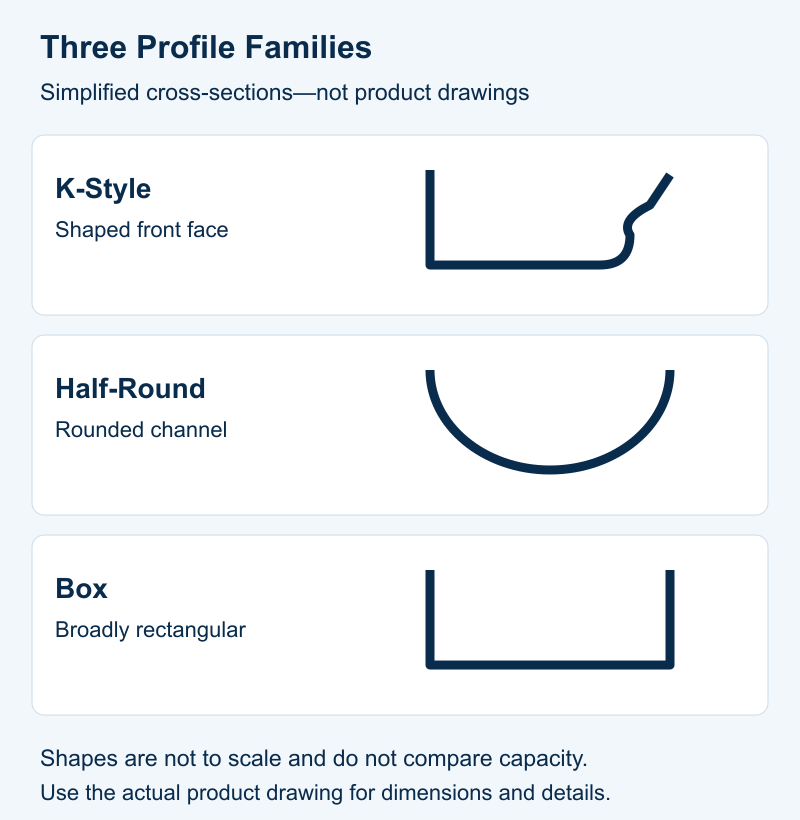
Profiles describe shape. Use the actual product drawing for dimensions and assembly details.
Seamless Gutters Still Have Connections
“Seamless” usually refers to a continuous formed length along a run. It does not mean that the whole perimeter of a house is one uninterrupted piece, or that the system has no potential connection points to inspect.
A continuous straight run still needs ends and an outlet arrangement. A change in direction may introduce a corner or miter. Water leaving the gutter enters other components. Englert's seamless gutter catalog lists end caps, miters, outlets, downspouts, elbows and supports alongside its gutter products. The component list is a useful reminder that seamless construction describes one aspect of an assembly.
Sectional gutters use supplied lengths joined along the route. Their connectors and installation details depend on the particular system. A continuous run can reduce intermediate straight-run joints compared with an arrangement made from shorter joined lengths, but that is not a promise of leak-free performance. Corners, outlets, ends, installation quality and the condition of adjoining parts still matter.
If a proposal emphasizes seamless construction, find out which runs are continuous, where the remaining connections will be and how those locations relate to the house. Where the selected system calls for movement provisions, those details must follow that system; there is no universal joint-spacing rule in this guide.
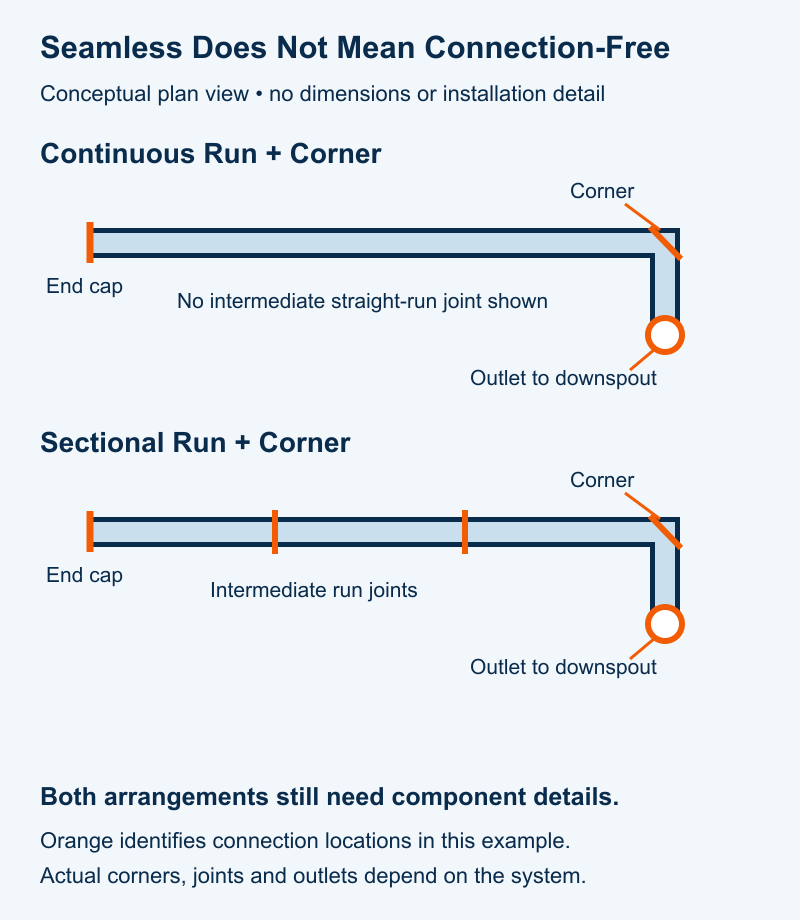
Both arrangements need component details. Orange marks connection locations in this conceptual plan.
Gutter Size Is a Separate Decision
Changing the body material does not, by itself, establish an improvement in water-handling capacity. Neither does adding the word seamless. A capacity recommendation needs the actual profile and dimensions, the roof area feeding each run, and an appropriate outlet and downspout arrangement.
PNNL's gutter and downspout guidance treats water collection and onward discharge as a connected route. ATAS also identifies roof size, rainfall, flow and drainage among the selection inputs for its rainware. The practical lesson is to evaluate the proposed arrangement, not assign performance to a metal name.
For a closer look at nominal size, roof catchment and outlets, read five-inch vs. six-inch gutters. A city-wide size recommendation or a comparison based only on the home's living area leaves important questions unanswered.
Read Three Common Proposal Descriptions
These are hypothetical wording examples, not company offers or customer estimates.
“Seamless Six-Inch Gutters”
You have a nominal size and a description of run construction. You still need the material, finish, profile, included runs, support arrangement, outlets and downspouts. Do not fill those gaps by assuming the proposal matches the house next door.
“Copper Half-Round Gutters”
You have a material and profile. The description does not establish exact dimensions, joint construction, compatible accessories or whether existing downspouts will remain. A product drawing and a clear list of retained components make the proposal more specific.
“Replace Gutters to Match Existing”
“Match” can mean appearance, dimensions, material, route or some combination. It may leave the most important decisions unresolved. Specify what will match, what will change, and which parts are excluded. A photo can help communicate appearance, but it is not a complete material or product identification.
Check the Parts Around the Gutter
The channel is only part of the work. A useful specification identifies these connections to the rest of the home:
- Supports and supporting surfaces. Identify the proposed support arrangement and any work involving the fascia or other adjoining surface. Keep concealed conditions explicit until they are assessed.
- Roof-edge interface. Establish how the proposed gutter fits the roof edge and any retained flashing or edge components. Matching the old front face does not resolve this detail.
- Outlets and downspouts. Name the included outlets, downspouts and routes. Retaining an existing downspout is a scope decision, not proof that its condition or capacity has been verified.
- Receiving route. Identify where water goes after the downspout. A pipe entering the ground does not identify its destination or establish its condition.
- Finish and appearance. Use the actual product information and an appropriate physical sample when appearance matters. Englert's catalog cautions that printed colors may differ from actual samples.
These checks help explain the work being purchased. They are not instructions for installing or modifying a roof drainage system.
A Short Gutter Specification Checklist
Before comparing two proposals as equivalent, check that both identify:
- The roof sections and gutter runs included.
- Body material and the relevant product specification.
- Profile and dimensions, supported by a drawing where needed.
- Finish or color and the sample used for comparison.
- Continuous or sectional run construction and remaining connection locations.
- Supports, outlets, downspouts and the onward water route.
- Existing parts being retained, associated work, exclusions and unresolved conditions.
If one proposal answers a question that the other leaves blank, clarify the difference before comparing only the totals. Our gutter installation estimate guide covers the broader scope, allowances and exclusions to keep together.
Questions About Gutter Types
Is K-Style the Same as Aluminum?
No. K-style describes the profile; aluminum identifies a material. A proposal can specify both, and manufacturer product ranges demonstrate that a profile family can be offered in different materials.
Does Seamless Mean There Are No Joints?
No. It describes continuous run construction. Ends, changes of direction, outlets and adjoining components still require details. The actual connection layout depends on the proposed system and the home.
Does a Larger Size or More Expensive Material Handle Heavy Rain Better?
A material name or price does not establish the capacity of the complete arrangement. The relevant comparison includes the profile, dimensions, contributing roof areas, outlets, downspouts and discharge route. A larger nominal size also needs a property-specific basis.
Can I Identify the Material From a Photo?
A photo may help show the shape or finish, but appearance alone does not establish the material specification or concealed condition. Use product records or an assessment when that distinction affects the work.
Choose a Complete Gutter System for Your Home
For gutter installation and replacement, start with the roof sections involved and what you want the new system to address. A clear proposal should connect the product description with the parts and routes that make it work.
Contact Atlanta Gutter Specialist about your project. You do not need to choose a metal, profile or size before getting help understanding the options for your home.
Sources and Further Reading
The manufacturer documents above establish examples of their own product terminology and components, not this company's inventory, endorsements or universal performance rankings. The PNNL educational guide was last updated September 26, 2021. Publication or revision dates were not established for the other cited pages and catalogs; all were consulted October 26, 2026. The Amerimax instructions are manufacturer-authored and hosted by Lowe's. Product details can change, so use the current instructions for the actual system proposed.