
A description such as “seamless gutters around the house” leaves practical details open. The house may have several roof edges, changes in direction and separate downspouts. A proposal should show which lengths are continuous, where connections remain and what will happen to adjoining components. That information is more useful than counting seams without knowing what they connect.
Compare the Run, Not Just the Label
Imagine a straight rear gutter and a porch gutter that turns a corner. The rear run may be formed as one continuous length. The porch arrangement still needs an explanation at the change in direction, even if its straight portions are continuous. “Seamless” does not make every roof edge one uninterrupted object.
Conversely, a sectional arrangement is not simply a continuous gutter cut at arbitrary points. Its supplied lengths, joining pieces and instructions belong to a particular system. Substituting an unfamiliar connector because the channel looks similar can leave the actual assembly unspecified.
K&M's K-style product information illustrates an important distinction: that supplier offers standard shipping lengths and custom seamless pickup lengths. Supply format and installed arrangement need to be read together. This is a manufacturer example, not a description of products supplied by Atlanta Gutter Specialist.
For a broader explanation of material, profile and nominal size, use our gutter types guide. Here, the focus is how the selected runs join and how those locations affect later decisions.
Draw a Connection Map Before Comparing Claims
A connection map can be a simple marked photograph or sketch, with no homeowner measurements or roof access. Give each included run a name, such as rear wall, porch or driveway side. Identify the ends, changes in direction and downspout locations from the proposal or assessment.
Then distinguish an intermediate straight-run joint from a corner, end cap or outlet. These locations do different jobs. Reducing one kind of connection does not remove the others.
Englert's catalog lists end caps, miters, outlets, supports and downspouts separately. Keep those component locations on the comparison sketch.
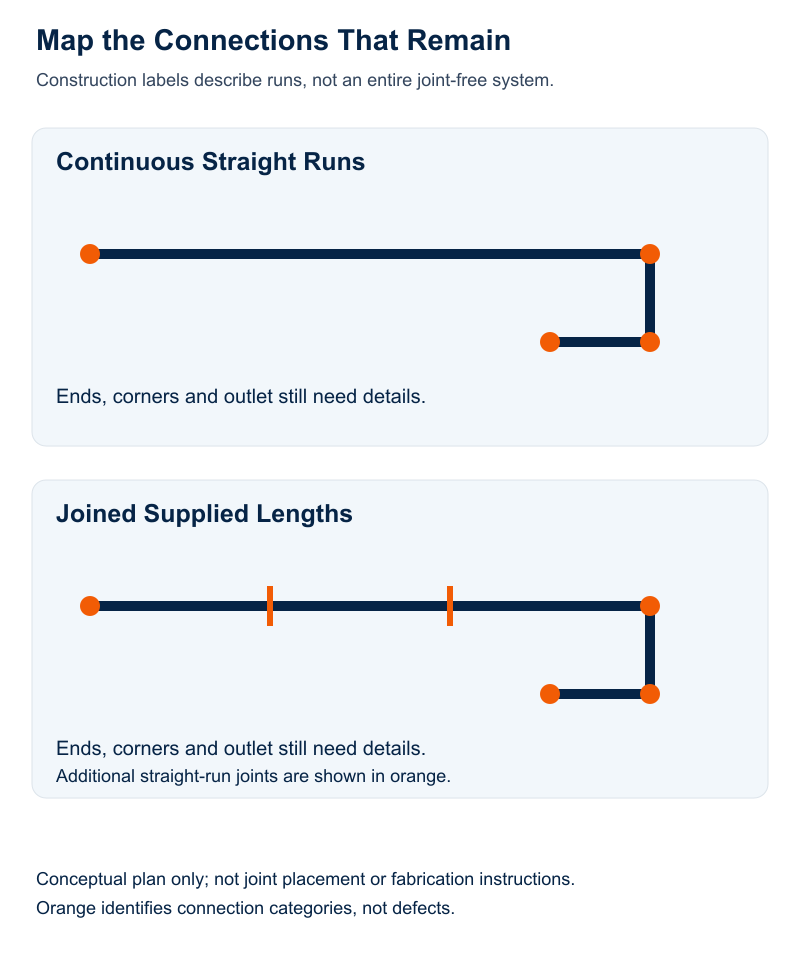
Both versions of the hypothetical roof-edge route retain their ends, corners and outlet. The difference is the intermediate straight-run connections. The comparison explains categories of connections, not a recommended location, fabrication method or installation detail.
Separate the Number of Joints From Their Condition
A continuous run can have fewer intermediate straight-run joints than a route assembled from shorter lengths. That does not provide a probability of leakage, a maintenance interval or a guarantee about the remaining connections.
A corner repair, for example, depends on the actual joint, adjoining pieces and support arrangement. Its significance cannot be read from the total number of seams elsewhere. A sectional connection also needs to be evaluated as the specified assembly, rather than dismissed because it contains a connector.
A useful comparison records what is new, what remains and what condition was established. “Existing downspout retained” and “downspout connection assessed and suitable for retention” communicate different information. Neither phrase should silently expand into a statement that every concealed downstream part was checked.
If a proposal is being driven by a leak, keep the observed location separate from the assumed cause. Our gutter repair mistakes guide explains why a visible wet spot is not enough to choose a repair method.
Understand What a Local Repair Would Involve
A smaller supplied piece is not automatically a simpler repair, and a continuous run is not automatically a whole-run replacement whenever a concern appears. Both conclusions require information about the actual product, condition and access.
Consider what must be reached or disturbed to work on the affected location. There may be guards over the gutter, an adjoining corner, retained roof-edge components or an outlet connected to a downspout. Those dependencies can matter more than the label on the gutter.
A clear repair description identifies the affected component and the adjoining pieces that will remain. It also identifies which conditions could change the method after assessment. That lets a homeowner compare a localized proposal with broader work without assuming either is appropriate in advance.
Do not loosen a guard, separate a connector or climb to investigate. Existing records and safely available ground-level photographs can identify the area for a professional assessment. An inaccessible detail should remain unknown in the record.
See How Two Named Assemblies Differ
New Tech Machinery's MACH II description explains a concrete manufacturing difference: its rollformer turns metal coil into a continuous gutter run. That forms the straight channel; the ends, direction changes and outlet still need their own components.
The Amerimax traditional vinyl instructions show supplied channel lengths, separate joiners and hooks. A connection between lengths is therefore an identified assembly, not simply a mark on the outside face.
| Named Example | What Is Physically Different | What the Label Still Leaves Open |
|---|---|---|
| MACH II rollformed run | Coil becomes a continuous channel length | Ends, corners, outlets and the installation arrangement |
| Amerimax traditional vinyl sections | Channel pieces meet through specified joining components | Suitable connections, supports and the complete route |
These examples are not a controlled comparison: they change material and construction together. They explain how the work differs, not which option performs better. A fair quotation comparison must still separate those attributes.
The distinction also helps read a repair description. A sectional repair may involve a channel piece and its connectors. Work on a continuous run may involve an end, corner, outlet or the run itself. The affected component—not the construction category alone—defines what needs assessment.
Work Through Two Hypothetical Proposals
Proposal A says “continuous rear gutter; existing outlet and downspout retained.” Proposal B says “new joined lengths; new outlet and downspout.” These are hypothetical descriptions, not customer estimates or company offers.
The first meaningful comparison is not seamless versus sectional. The proposals include different downstream components. Separate the work into rear run, joints, outlet and downspout before comparing their totals. Otherwise, the construction label may receive credit or blame for a difference in scope.
Now imagine that both proposals cover identical locations and components, but one includes removing and refitting guards while the other leaves that work unresolved. Access still differs. A revised scope record can expose that difference without assigning a universal advantage to either construction method.
Once the included work is aligned, the remaining questions become more precise: which product or fabrication is proposed, where its connections fall, how retained parts are handled and what information will be supplied for future care.
Use a Run-and-Connection Worksheet
Use this table with actual proposals. Enter “not confirmed” where the documents do not answer a field; a blank is not proof that a component is excluded or defective.
| Record Field | Proposal A | Proposal B |
|---|---|---|
| Named roof edges and runs included | Record locations | Record locations |
| Continuous lengths or joined supplied sections | Record the proposed arrangement | Record the proposed arrangement |
| Ends, corners and intermediate connections | Mark each category on the sketch | Mark each category on the sketch |
| Outlets and downspouts | Separate new from retained | Separate new from retained |
| Existing guards and repair access | Record removal and refitting responsibilities | Record removal and refitting responsibilities |
| Supporting surfaces and unresolved conditions | Record assessment limits | Record assessment limits |
| Product information and care records | Identify documents to keep | Identify documents to keep |
This is an original comparison record, not a sizing chart or installation plan. Keep it with the proposal so the description of the work can be understood later.
Remember What Seam Construction Cannot Answer
The gutter still has to collect roof water and convey it onward. PNNL's gutter and downspout guidance treats collection and discharge as connected parts of that route.
A seamless description does not identify the contributing roof areas or establish outlet capacity. A sectional description does not establish the destination of a buried connection. Those are separate design and assessment questions. If nominal size is part of the choice, read five-inch vs. six-inch gutters rather than assume construction method supplies the sizing answer.
Questions About Seamless and Sectional Gutters
Are Seamless Gutters Completely Joint-Free?
No. Continuous run construction does not remove ends, changes in direction, outlets or adjoining components. Read the arrangement for each included roof edge.
Does One Leaking Connection Mean the Whole Run Must Be Replaced?
The leak location alone does not settle the scope. The condition, adjoining parts and suitability of a repair need assessment. A connection map helps identify the actual area without choosing the method in advance.
Is a Sectional System Always Easier to Repair?
No universal conclusion follows from supplied section length. The product, connections, guards, access and retained components affect what the work involves.
Can I Compare the Options by Price per Foot Alone?
Only after identifying the actual products and included work. Different outlets, downspouts, removal or access arrangements can make the totals describe different jobs.
Choose the Arrangement for Your Project
For gutter installation and replacement, bring the roof edges involved and any existing components you hope to retain. If the concern is localized, explore gutter repair before assuming a construction label decides the scope.
Contact Atlanta Gutter Specialist to discuss your home and the work you are considering.
Sources and Method
Manufacturer examples explain their own products and terminology, not company inventory, comparative testing or guaranteed performance. Issue dates were not established for the cited manufacturer pages and documents. PNNL lists September 26, 2021 as its last update. Sources checked October 26, 2026. The examples, worksheet and proposed diagram are original conceptual aids.