
This guide focuses on seams, corners, end caps and outlet connections. It helps you read a repair recommendation, not apply a sealant or dismantle a gutter. Start with observations you can make safely from the ground and any records of earlier work.
Identify the Connection You Are Talking About
A straight-run joint connects lengths of gutter. A corner or miter changes direction. An end cap closes a run, while an outlet transfers water into the downspout. These locations are different even when the homeowner describes each as “the seam.”
Name the location in a way someone else can find: “the outside corner above the patio” is more useful than “the left joint.” Mention whether the drip occurs during rain, continues afterward or appears in more than one place. Do not assume the nearest visible connection is the source until the water path is assessed.
“Seamless” does not remove all these locations. Our seamless-versus-sectional guide explains run construction and the connections that still remain.
Compare Repair Scope at Four Common Locations
| Location | Useful Finding to Identify | Detail to Keep in the Proposal |
|---|---|---|
| Straight-run seam | Condition of adjoining lengths and their connection | Preparation, connection work and retained material |
| Corner or miter | The identified escape point and surrounding condition | Which corner components change and which remain |
| End cap | Cap, edge and connection condition | Retain or replace the cap; applicable sealing work |
| Outlet connection | Connection condition versus a separate flow restriction | Joint repair, outlet assessment and any separate downspout work |
These are comparison prompts, not four standard repair recipes. A drip at an outlet can lead to both a connection question and a downstream-flow question. Keep them distinct so a repair to one is not mistaken for verification of the other.
Separate Water Passing Through From Water Arriving From Above
Water can be seen below a connection without the observation establishing how it got there. A repair assessment needs to distinguish the connection itself from water reaching the area from another route.
GAF's drip-edge guidance describes directing roof-edge water into the gutter in its shingle-system context. It helps explain why a roof-entry question may need a different assessment from a leaking gutter joint. It does not diagnose an individual roof or make this company a roofing-service provider.
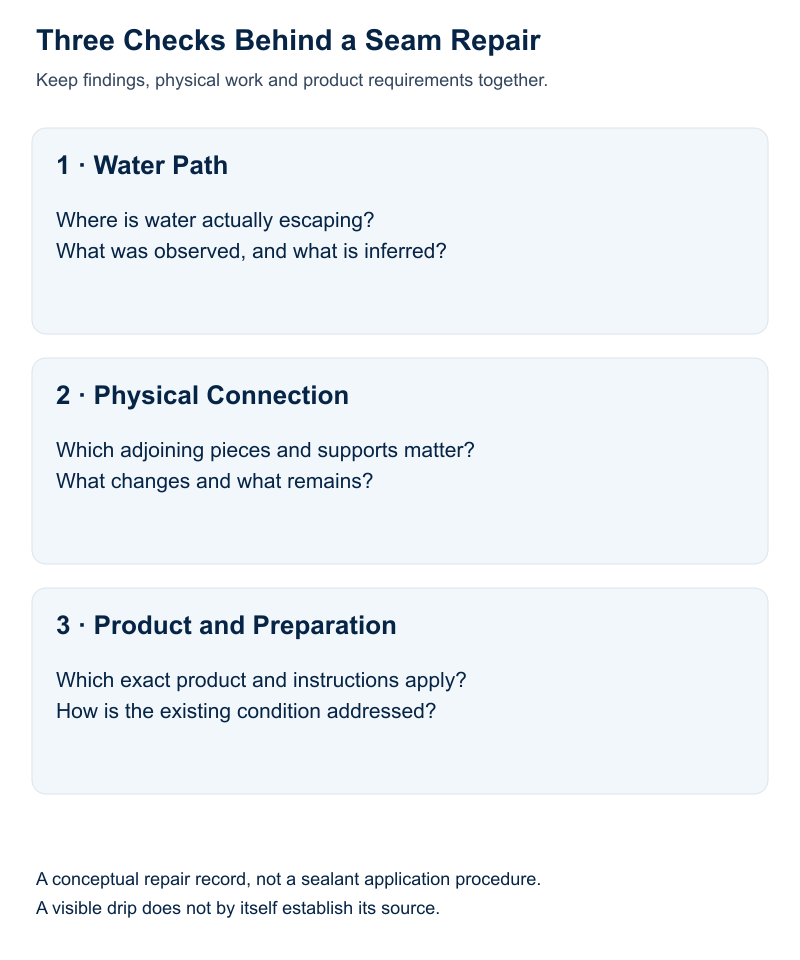
Describe where you see water and where you cannot see. If the back edge is concealed, say so. Avoid filling that gap with a confident diagnosis based on a stain. Read water behind the gutter when the concern appears between the gutter and the building rather than clearly at a connection.
Check the Physical Joint as Well as the Seal
A repair explanation should identify the condition of the adjoining pieces, their connection and any supporting hardware relevant to the leak. A product intended to seal a seam is not, by that description, a replacement for a damaged component or its support.
The Standard Work Specifications gutter detail lists mechanical connection and compatible sealing separately. Treat that as a useful distinction, not a universal instruction for every gutter product or an Atlanta legal requirement.
If a joint has separated or a section has moved, ask what would hold the repaired arrangement in its intended position. If the surrounding material is damaged, identify whether the proposed work retains it or replaces it. The word “reseal” does not answer those questions.
Use the Instructions for the Actual Sealant
Brand names, formulation identifiers and intended applications matter. The current Geocel 2320 product page notes formulation changes associated with part numbers. Its manufacturer-linked product data sheet separately addresses preparation and limitations.
The practical lesson is to connect the proposed product with the actual substrate, existing coating and earlier repair material. A broad adhesion claim does not describe the condition of the surface at your joint. The manufacturer example is not a recommendation or a claim that Atlanta Gutter Specialist uses that product.
Ask which instructions apply to the product being supplied and how the proposed preparation follows them. Avoid treating an old online sheet as interchangeable with every current version. Do not choose a product by a headline about flexibility or wet-surface adhesion alone.
Keep Previous Repair Material in the Connection Record
Name any earlier work at the affected connection. If its product is unknown, record that limit rather than identify it from color. The proposal needs preparation appropriate to the actual findings and selected product. Our gutter repair mistakes guide explains the wider preparation and prior-material questions; the location-specific table above keeps this guide focused on the connection being repaired.
A Worked Example: A Corner Repaired Twice
Imagine a homeowner says a rear corner has been sealed twice and is dripping again. This is a hypothetical case, not a completed project.
The repair history is useful evidence, but it does not prove the next repair needs a stronger sealant. A new assessment might need to review the water's entry path, the physical corner connection, surrounding support and the earlier material. What matters is which findings are actually established.
Compare “reseal the corner” with a record that identifies: the confirmed escape point; connection components being repaired or replaced; the selected product and required preparation; retained parts; and anything unassessed. Missing details remain questions to resolve.
The homeowner should also know what has not been assessed. If adjoining roof-edge work or a connected downspout remains outside scope, record that limit rather than infer it is sound. Keep those unassessed dependencies beside the proposed connection repair.
Keep a Before-and-After Connection Record
Record the affected connection, the observed symptom and what the assessment established. Add the proposed product or component, preparation, parts retained and any associated support work.
After the work, compare the reported changes with that record. Keep product information when supplied and note remaining restrictions, concealed areas or separate work. Do not record a proposed test as completed unless it actually happened.
The FTC's home-improvement guidance recommends written estimates describing work, materials, timing and price. The connection record here is an original way to organize those details; it is not mandatory contract language or a legal interpretation.
Common Questions About Leaking Gutter Connections
Can a Leaking End Cap Be Repaired Without Replacing the Whole Run?
That depends on the cap, adjoining material and connection condition. A localized repair may be considered when supported by the assessment; the visible drip alone does not establish the scope.
Is More Sealant Always the Answer?
No. Identify the escape path, connection condition and preparation first. Product choice should follow those findings and the applicable instructions.
Does Seamless Mean My Gutters Cannot Leak?
No. Continuous runs still have ends, outlets and changes of direction that need their own details. The complete arrangement matters.
Can I Compare Sealants by Their Flexibility Percentage?
A technical property is not a universal rating for the joint on your home. Compare the intended use, substrates, limitations and actual repair arrangement rather than one advertised number.
Discuss the Leak and the Previous Work
For gutter repair, describe the connection and any earlier attempts to address it. If the concern affects several runs or surrounding material, our repair-or-replace guide helps frame the broader decision.
Sources and Review Method
Research checked October 26, 2026. This is a document-based guide to evaluating a connection repair, not a DIY method or property diagnosis. Manufacturer instructions apply to their specific products and versions. The diagram, hypothetical example and connection record are original editorial aids; no product testing, company inventory or warranty coverage is asserted.