
The most useful repair explanation connects a finding to a specific change. “Reseal the rear corner” names a task. It does not explain whether the joint is supported, which existing materials are involved or what evidence identifies that connection as the water source. This guide helps you evaluate the completeness of a repair proposal without turning it into a do-it-yourself procedure.
Mistake 1: Naming the Repair Before Establishing the Finding
Start with a clear distinction between an observation and a cause. Water below a corner is an observation. A failed joint, water reaching the area from above or a problem farther along the route are possible explanations that need assessment.
Describe what was seen, where it happened and when. A useful location might be “rear corner above the patio,” supported by an existing photo taken from a safe position. Keep the repair history with that record. If the same area was worked on before, note what was changed rather than assuming the old repair proves the current cause.
A proposal is easier to evaluate when it separates three things:
- Finding: what was observed or established about the affected area.
- Proposed change: what the repair would alter.
- Limit: what has not been assessed or will remain outside the work.
For example, “water appears below this corner; connection assessment pending” is more accurate than recording “sealant failed” before anyone has established that. These are hypothetical examples of recordkeeping, not diagnoses of a customer's home.
Mistake 2: Treating Sealant as the Support System
Sealing a connection and keeping its components positioned are different functions. A repair that proposes a new sealing material should still account for the parts the seal must join and how those parts are supported.
Englert's architectural guide specification treats adjoining work, hangers, components and movement as separate considerations. It is a specification for that manufacturer's system, not a universal repair manual. It illustrates why “apply sealant” is not a complete description of every issue around a joint.
A new fastener does not, by itself, document the condition of the material receiving it. Likewise, a newly sealed joint does not establish whether adjoining sections remain properly positioned. The assessment needs to distinguish the connection from its supporting surfaces and the rest of the assembly.
This does not mean every leak needs new supports or fascia work. It means the explanation should say whether those conditions were assessed, whether a related change is needed and what remains unknown. Avoid a recommendation that jumps from a photo to a confident diagnosis of concealed decay.
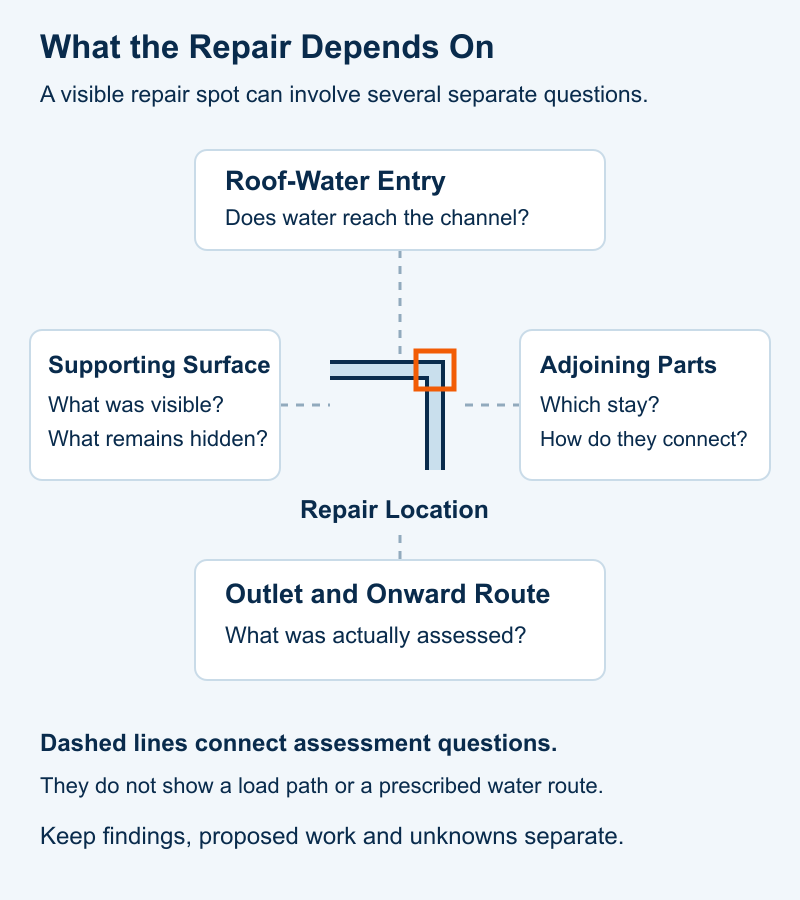
A repair location can depend on several surrounding conditions. The links identify assessment questions, not a prescribed repair detail.
Mistake 3: Confusing the Leak Location With the Water Entry Point
Water noticed behind or below a gutter is not automatically escaping through a gutter seam. The route from the roof edge into the channel is a separate part of the assessment.
GAF's drip-edge bulletin, in its asphalt-shingle context, explains how roof-edge detailing directs water toward the gutter rather than down the building face. That supports an important boundary: a gutter connection repair and a roof-edge water-entry problem do not describe the same work.
A stain alone cannot establish which detail is responsible. Before assigning another patch, identify what evidence connects the water to the proposed repair location. If the concern involves the roof interface, keep that issue explicit rather than hiding it inside a vague “gutter leak” label.
Our water-behind-the-gutter guide explains these pathways in more detail. A roof-edge question does not establish that Atlanta Gutter Specialist provides roofing work or that a particular flashing change is required on your home.
Mistake 4: Choosing a Product Without Its Preparation Requirements
A product's adhesion claim does not describe the entire repair method. The actual surface, existing coating, previous repair and product instructions still matter.
A concrete example appears in Geocel's 2320 documentation. Its manufacturer product information describes adhesion under challenging surface conditions. The manufacturer-linked product data sheet separately specifies clean, dry surfaces free of foreign matter for best results. Reading only the headline misses the preparation section.
That example is not a recommendation for a particular sealant or a claim that our company uses it. The manufacturer lists different part numbers and a formula transition; the exact product and applicable current instructions need to be identified. Do not combine instructions from an older sheet with a different current formulation.
For a proposed repair, the practical questions are specific:
- What material and existing finish will the repair meet?
- What previous sealant, coating or contamination is present?
- Which exact product and instructions apply?
- What preparation is included before the new material is applied?
- What condition would make that method unsuitable or require a revised approach?
You do not need to choose solvents or prepare the joint yourself. You need a proposal that explains the actual method well enough to distinguish product selection from surface preparation.
Mistake 5: Applying a Universal Rule to an Earlier Repair
“Always remove every trace of old sealant” and “just add more over the top” are both too broad to use as universal gutter-repair advice.
The Geocel data sheet above has different directions for resealing and maintenance. The relevant procedure depends on the product, the existing condition and the kind of work being performed. A general article cannot choose between those procedures for a particular joint.
Keep the previous repair in the assessment. Identify the material if records are available, what is visibly damaged and what is still uncertain. If the proposed method depends on compatibility with an earlier product that has not been identified, that uncertainty deserves an answer before it is treated as settled.
An assessment may support a targeted repair, a different method or broader work. The useful explanation is the connection between the finding and that choice, not a blanket rule about every previously repaired gutter.
Mistake 6: Ignoring Movement and Adjoining Materials
A connection has to work with the assembly around it. Material compatibility and movement are product- and system-specific questions, not details answered by a color match or a general claim that a sealant is flexible.
The Englert specification cited earlier includes movement-related support considerations for its system. That is a reason to establish which details apply to the actual assembly, not to copy a hanger spacing or movement allowance into a repair proposal from this guide.
Similarly, a laboratory stretch figure for a sealing material is not permission to use it as structural support or a universal allowance for a gutter joint. Ask how the proposed product and connection suit the parts being retained.
Where different metals or upstream materials are involved, use the copper and aluminum compatibility guide for the distinction between contact and runoff. A matching painted finish does not identify the underlying material or establish compatibility.
Mistake 7: Calling Retained Parts “Checked” Without Saying What That Means
A repair can be limited in scope without being incomplete. The problem arises when a limited repair is described as though the entire route has been verified.
PNNL's gutter and downspout guide considers collection and onward drainage together. For a repair record, identify the adjoining run, outlet, downspout and any connected drain that were actually assessed. Keep “retained” separate from “verified.”
A retained downspout might be outside the proposed work. A pipe entering the ground may have an unknown destination or concealed condition. Neither fact should quietly become “the drainage system is fine.” Equally, an unknown does not prove a defect or justify replacing everything.
Use clear status words:
| Status | What the Record Should Explain |
|---|---|
| Observed | What was visible, where and under what conditions |
| Assessed | What was examined and the finding or limit of that assessment |
| Proposed Change | Which component or detail the repair will alter |
| Retained | What stays and whether its condition was assessed |
| Unresolved | What remains unknown and how it affects the next decision |
Those labels are editorial tools, not inspection certifications. They help prevent a claim about one joint from expanding into an unsupported claim about the entire home.
Mistake 8: Repeating a Repair Without Keeping the Earlier Findings
If a concern returns, bring the earlier repair description, date and any safely available photos into the new assessment. Record whether the same visible location is involved and what has changed. Do not infer that the same location proves the same cause.
The next explanation should account for the earlier work. Was the original finding confirmed? Which parts were retained? Is the current proposal changing the method, the affected area or the scope? What evidence supports that change?
If recurring overflow is the main concern, the overflow-after-cleaning guide addresses that separate troubleshooting question. If the choice has become localized repair versus broader replacement, use the repair-or-replace guide. Neither recurring water nor an earlier patch, by itself, settles the decision.
Keep a Repair Findings Record
A short record can connect the assessment to the work without becoming another price-comparison tool. Give each affected location its own entry:
Location and observation: where the concern appears, the date and the safely available evidence.
Established finding: what the assessment supports, with any limits stated.
Proposed change: the component, connection or supporting detail being altered.
Retained parts: what stays and what was actually checked.
Unresolved question: what remains unknown and who will confirm the next step.
For example: “rear corner connection to be repaired; adjacent downspout retained; concealed drain route not assessed” describes a boundary. It does not claim that the connected drain caused the leak or that underground work is needed.
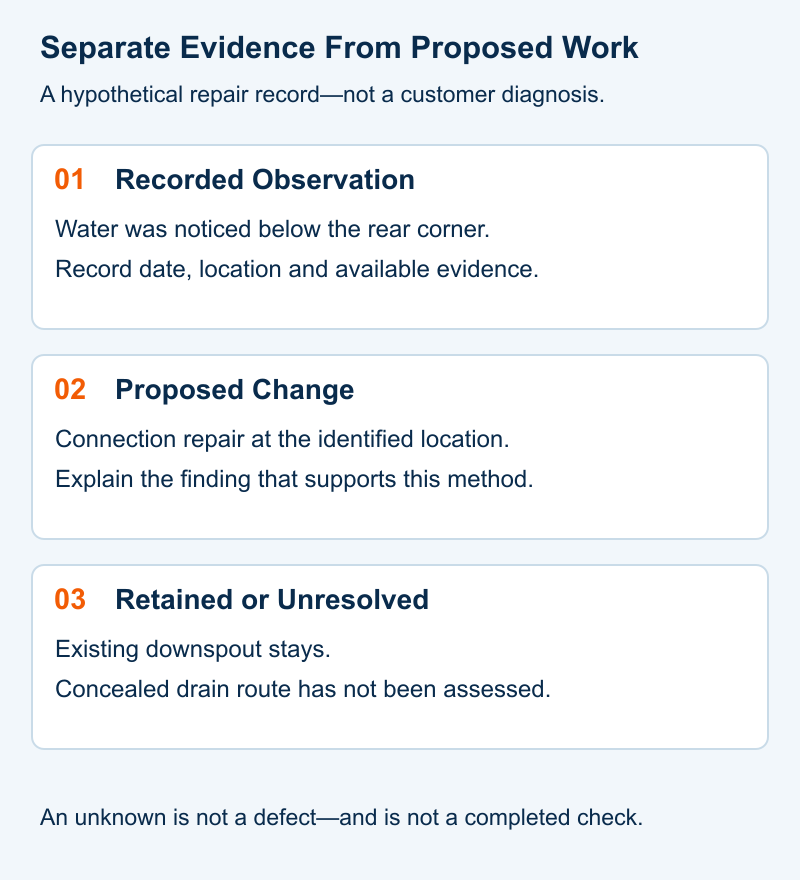
Keep the observation, proposed work and unassessed parts in separate fields.
Record Changes When the Findings Change
If further assessment changes the proposed repair, keep the new finding and revised work together. Do not rely on an old one-line description to explain a different job.
FTC guidance supports clear written descriptions of work, materials and promises. Applied here, that means recording what changed in the proposed repair and any related price or timing implications. This is practical communication, not a universal change-order law or a statement about contract rights.
The revised explanation should make clear whether the original repair remains appropriate, what additional decision is needed and which conditions are still unresolved. A good record preserves uncertainty instead of replacing it with a confident-sounding assumption.
Questions About Gutter Repairs
Does a Leaking Corner Always Need More Sealant?
No single action follows from the location alone. The assessment should establish the water source, condition of the connection, supporting arrangement and materials involved. Sealing may be part of an appropriate repair, but the visible wet spot does not establish the whole method.
Does a New Fastener Prove the Fascia Is Sound?
No. Installing a fastener and establishing the condition of the supporting surface are different questions. Record what was assessed and what could not be seen; do not diagnose concealed damage from a photograph alone.
Is Applying Sealant Over an Earlier Repair Always Wrong?
There is no universal answer independent of the product and condition. Read the applicable current instructions and establish which preparation and repair procedure fits the actual joint. This guide does not prescribe a resealing method.
Should I Climb Up to Photograph the Connection?
No. Provide existing records or photos only if safely available. The CPSC warning about ladders and overhead wires is one reason not to turn evidence gathering into roof-level work. Keep away from unstable components and other hazards, and explain what cannot be seen.
Get Help With the Affected Area
For gutter repair, describe the location, what you noticed and any previous work. The useful next step is an assessment tied to the actual connection and adjoining parts, rather than selecting a patch from a general article.
Contact Atlanta Gutter Specialist about your gutter concern. Keep the repair findings and the limits of the proposed work together so you can understand what the recommendation would address.
Sources and Review Notes
Primary sources linked above include Englert's guide specification, GAF's asphalt-shingle roof-edge bulletin, Geocel's product information and linked data sheet, PNNL's water-route guide, FTC consumer guidance and the CPSC electrical-hazard warning. Manufacturer examples are not endorsements, company-used-product claims or universal installation instructions. PNNL lists September 26, 2021 as its last update; FTC lists July 2022. Other document issue dates were not clearly established; document codes are not presented as new publication dates. Consulted October 26, 2026. The diagrams and repair record are original conceptual aids, not an assessment or engineered repair detail for a property.