
The most useful comparison begins with what matters to your project. You might be replacing one visible porch run, changing the whole roofline or trying to retain existing downspouts. Those are different jobs. A proposal should connect the material choice to that job, rather than sell a broad promise about which metal is best.
Separate the Metal From the Shape
Copper is not another name for half-round, and aluminum is not another name for K-style. Berger's half-round product page lists copper and aluminum within the same profile family. K&M's K-style range provides another manufacturer example of material choices within a named shape.
These examples establish terminology, not that every size, finish or combination is offered by this company. Use the actual product description when comparing your options.
This separation makes a practical difference. If one proposal specifies copper half-round and another specifies aluminum K-style, both the metal and the shape have changed. An appearance preference cannot be assigned entirely to the material. Compare the profile drawings first, then identify which differences remain about the metal and finish.
Our gutter types guide separates those attributes. The purpose here is to help you compare the material-related specifications without losing track of the rest of the assembly.
Decode Ounces and Decimal Thickness
Copper and aluminum descriptions can use different measurement conventions. Conklin Metal Industries' sheet-copper explanation, a first-party metal supplier resource, defines the copper ounce designation as weight per square foot. It is not the weight of one finished gutter or one linear foot.
K&M's product page identifies aluminum stock using decimal-inch thickness and copper stock using ounce descriptions. Those are different ways of specifying sheet material, not numbers to compare directly.
| Example Wording | What the Number Describes | What It Does Not Describe |
|---|---|---|
| 16-ounce copper | Sheet weight per square foot | Weight of a complete gutter run |
| .027-inch aluminum | Sheet thickness | Channel width or water capacity |
| Six-inch gutter | Nominal gutter size | Sheet thickness or material weight |
These are examples of reading labels, not recommended specifications. The metal, formed profile, supports and connections still affect the assembly. A larger written number in one convention cannot rank it against a number in another.
For two proposals, keep the units beside the material and product. That makes a substitution visible and avoids confusing a change in channel size with a change in the stock being formed.
Distinguish Copper Metal From a Copper-Looking Finish
K&M lists a Copper Penny finish within its colored aluminum range. The color name does not turn the underlying aluminum into copper. This is a concrete reason to record substrate and finish separately.
Actual copper has its own appearance question. The Copper Information Center's surface-evolution explanation describes environmental exposure influencing its surface over time. That does not provide a timetable for the color of a gutter on your house.
A new sample and an aged porch gutter are therefore different references. Decide whether “match” means the same metal, the same profile or the current visible color. Do not assume new copper immediately matches an older surface, or that a copper-colored coating develops the same appearance as exposed copper.
Keep the selected product and finish information with the proposal. Appearance remains a separate decision from water collection and the condition of adjoining parts.
Compare a Named Joint Method, Not Just a Metal
K&M's material discussion describes mechanically joined aluminum and soldered copper connections within its range. The useful difference is that the proposed joint method is part of the specification; it cannot be inferred from a color or profile.
| Description | What It Identifies | What Still Needs Identifying |
|---|---|---|
| Copper gutter | Body material | Run construction and actual joint method |
| Soldered copper connection | A named joining approach | Components, location and applicable fabrication detail |
| Aluminum gutter with mechanically joined connection | Material and a connection approach | Components, sealing and the product-specific arrangement |
These examples are not universal methods for every copper or aluminum product. They do not justify a homeowner soldering or resealing procedure. A repair proposal should identify the method appropriate to the actual retained and new parts.
Our seamless-versus-sectional guide explains the separate question of where connections remain in a continuous or sectional route.
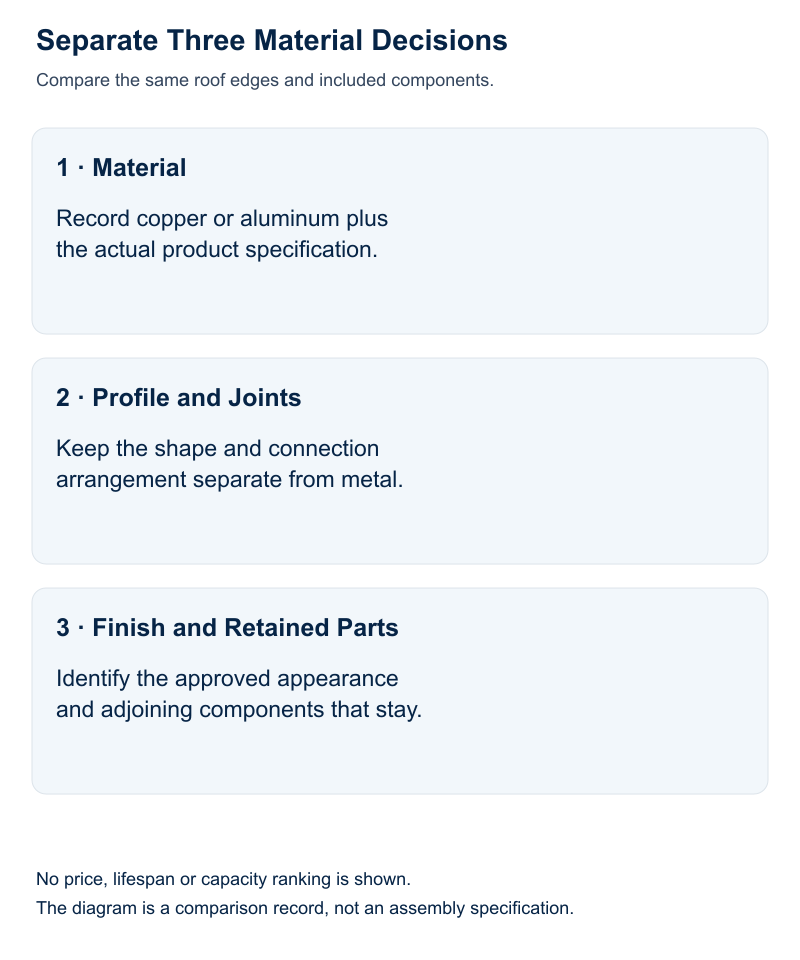
The diagram separates material, finish and joint descriptions for the same hypothetical roof edge. It is a comparison framework, not a recommended connection detail.
Treat Supports and Downspouts as Their Own Decisions
A new metal gutter body does not establish whether its existing supports, fascia-side surfaces, outlets or downspouts can stay. Retention requires a basis for the actual project.
ATAS rainware information identifies several profile and downspout forms and notes roof size, rainfall, flow and drainage as selection inputs. Its product examples illustrate why the channel and onward route should be specified together.
Do not investigate by climbing, removing guards or separating connections. Safely available records and ground-level photographs can identify the area. The proposal can state which details need closer assessment.
Leave Compatibility to Its Dedicated Review
Changing a material can introduce interfaces with existing parts. Record those actual materials and locations instead of assuming a similar painted color establishes compatibility.
Our copper and aluminum compatibility guide explains direct contact and upstream runoff as separate questions. That guide addresses the mechanism in depth; this material-choice record should identify the parts that need that review.
The presence of copper somewhere on a home does not, by itself, decide whether a particular aluminum component must be replaced. Nor does choosing copper remove the need to assess adjoining materials. Keep the actual connection and water route visible rather than make a whole-house inference from one label.
Work Through a Hypothetical Porch Replacement
Imagine that Proposal A describes copper half-round gutters and new matching downspouts. Proposal B describes aluminum gutters but retains the current downspouts. These are hypothetical examples, not company offers or completed projects.
Start by aligning the work. Are the same porch edges included? Is the aluminum profile identified? Which corners and outlets change in each option? The proposals are not yet simply two prices for different metals.
Next, compare appearance references. The homeowner wants the shape and character of an older porch gutter but has not decided whether that means the same metal or the same current color. That is a selection question to resolve with actual product information, not an opportunity to promise a guaranteed aged appearance.
Finally, list the retained parts and joint boundaries. Once both proposals identify them, the homeowner can see which differences are aesthetic, which concern the assembly and which reflect additional work. That is a more useful decision than choosing a material on a universal lifespan or price claim.
Use a Material-and-Assembly Worksheet
Fill this record from the actual proposal and documents. Enter “not confirmed” where a choice or condition remains open.
| Comparison Field | Copper Proposal | Aluminum Proposal |
|---|---|---|
| Exact product or material specification | Identify the source information | Identify the source information |
| Profile and dimensions | Keep the drawing | Keep the drawing |
| Finish and appearance reference | Record the selected sample or treatment | Record the selected sample or finish |
| Included roof edges and runs | List locations | List locations |
| Run construction and remaining joints | Record the actual arrangement | Record the actual arrangement |
| Supports, outlets and downspouts | Separate new from retained | Separate new from retained |
| Existing-material interfaces | Identify locations needing review | Identify locations needing review |
| Care information and unresolved decisions | Keep instructions and open items | Keep instructions and open items |
This original worksheet makes differences visible; it does not assign a material score. For full pricing inclusions and exclusions, use our gutter installation estimate guide.
Questions About Copper and Aluminum Gutters
Does Copper Automatically Handle More Rain?
The metal name does not establish the capacity of the complete system. Compare the actual profile, dimensions, contributing roof areas, outlets and downspouts. The five-inch vs. six-inch guide explains that separate sizing question.
Are Copper Gutters Always Half-Round?
No. Material and profile are separate attributes. Manufacturer examples include different material options within named profile families; identify the actual product rather than infer its shape from the metal.
Will New Copper Immediately Match Existing Copper?
Do not assume an immediate match or a guaranteed weathering schedule. Identify the existing appearance and the new product's specified finish, then keep any uncertainty about the result explicit.
Can Existing Aluminum Downspouts Remain With New Copper Gutters?
That needs a project-specific review of the actual materials, connections, water route and condition. Record the retained parts and use the compatibility guide instead of assuming either automatic suitability or automatic replacement.
Compare the Complete Installation
For gutter installation and replacement, bring the roof edges involved, the appearance you want and the existing parts you hope to keep. Compare the named assemblies and included work before choosing a material.
Contact Atlanta Gutter Specialist about your project. The starting point is the work your home needs, not a universal winner between two metals.
Sources and Method
Berger, K&M and ATAS describe their own product families, not company inventory or independent comparative testing; publication dates were not established. The Copper Information Center page lists October 3, 2023 as its last update. Conklin’s unit explanation is dated February 12, 2020. Sources checked October 26, 2026. Hypothetical examples, the worksheet and diagram concept are original editorial aids; no price, lifespan or performance ranking is supplied.