
Good preparation prevents a simple misunderstanding from becoming a construction decision. “Replace the front gutters,” for example, may not explain whether the porch, upper roof, downspouts or connected drain are included. This guide starts after you have selected proposed work and helps you turn those details into a usable project record.
Start With One Current Version of the Work
Keep the accepted proposal, any drawings and later written changes in one place. Mark which version is current. A photograph of an earlier estimate and a separate text message about a changed downspout can otherwise leave two people working from different instructions.
Use a simple location description for each part of the house: front porch, driveway side, rear addition or upper roof. If “left” might mean different things depending on where a person stands, add a photo or a small labeled sketch. The goal is to identify the same location consistently, not to prepare a technical drawing yourself.
FTC consumer guidance recommends written descriptions of work and materials and keeping promises in the agreement. For installation preparation, that becomes one practical check: can the people involved identify the same current scope?
If you are still choosing between proposals, use the gutter installation estimate guide first. The preparation steps below assume that the work itself has been selected, while leaving unassessed conditions explicit.
Identify What Will Be Replaced and What Will Stay
Walk through the scope on paper before the work area becomes busy. A new gutter body does not automatically mean new downspouts, new roof-edge flashing or a new underground drain.
| Part of the System | Record Before Work | Why It Matters |
|---|---|---|
| Gutter runs | Included roof sections and any excluded porch or addition | A location label prevents assumptions about the perimeter |
| Corners and outlets | New, retained or still to be assessed | Connections can involve both new and existing parts |
| Downspouts | Which are replaced, retained or rerouted | A gutter replacement does not define every onward route |
| Guards | Removal, retention, replacement or reinstallation responsibility | Access and the final assembly depend on the actual product |
| Roof edge and fascia | Known associated work and conditions not yet assessed | Concealed findings may change the proposed approach |
| Connected drain | Known connection, agreed work and unknown destination or condition | A pipe entering the ground does not identify the complete drainage route |
These are planning fields, not a list of services included in every installation. Keep “not assessed” separate from “no problem found.” If something is outside the gutter work, name that boundary instead of assuming someone will address it later.
The Englert gutter catalog shows why a system includes more than a channel: it lists outlets, corners, supports, downspouts and other components. It is one manufacturer's system reference, not a statement that your project includes all those parts.
Agree on Ground-Level Access Before Arrival
Point out access conditions while there is time to discuss them. The work provider determines equipment placement and safe working methods; the homeowner can identify ordinary use of the property and any restrictions that may affect planning.
Useful details include the driveway used by the household, gates, shared paths, narrow side yards, parked vehicles, outdoor furniture and areas you do not want used for storage. Explain where people normally enter and leave the home. Ask which areas need to remain clear and when, then record the agreed arrangement.
Avoid moving heavy objects, attached fixtures or anything near overhead wires just to prepare. Do not guess where a ladder or vehicle should be placed. If an object cannot be safely moved through an ordinary household action, identify it and leave the method to the people responsible for the work.
For a household with children or pets, agree which doors, gates and outdoor areas should remain out of use while work is under way. This is a coordination prompt, not a complete site safety plan. A gate being closed for a pet, for example, does not establish that the work area is secured.
Share Property Details Without Trying to Diagnose Them
Useful preparation is specific. A dated photo labeled “rear addition, stain below corner” is more informative than “the back is bad.” Describe a concern and its location, then keep the cause open until assessed.
Prepare a short list of details that may affect the work:
- A previous repair and any records you have for it.
- A downspout or drain connection that disappears from view.
- An area where water behaves differently during rain.
- Roofing, painting or other work already planned near the same edge.
- A gate, narrow route or fragile item near the proposed work area.
- Any area that has not been visible or accessible for assessment.
Do not create evidence by climbing, opening a joint or running water over a problem. Existing ground-level photos and documents are enough to communicate what you know. If a condition changes before the agreed work, report the change rather than silently treating an older assessment as current.
The CPSC's ladder and electricity warning specifically addresses the danger of ladders near overhead wires, including when people clean gutters or trim trees. Homeowner preparation should not become an instruction to do those tasks before an installer arrives.
Set a Clear Contact and Change-Decision Route
Choose how the work provider can reach you if a finding needs a decision. If someone else will respond, make clear which decisions that person is authorized to make. A person opening a gate is not necessarily the person approving a material change or additional work.
Agree how the finding will be explained, how revised work will be recorded and how the relevant decision will be confirmed. Keep the affected location, proposed change, any price or timing implications and unresolved questions together. This is practical recordkeeping, not a universal legal approval procedure.
A useful question is: what happens if the supporting surface is different from what could be seen beforehand? Do not require a confident diagnosis of concealed conditions before they can be observed. Instead, agree how that discovery will be communicated and how the next step will be decided.
Georgia Consumer Ed recommends keeping the contract, changes, plans, correspondence and product information together. That supports maintaining a coherent record.
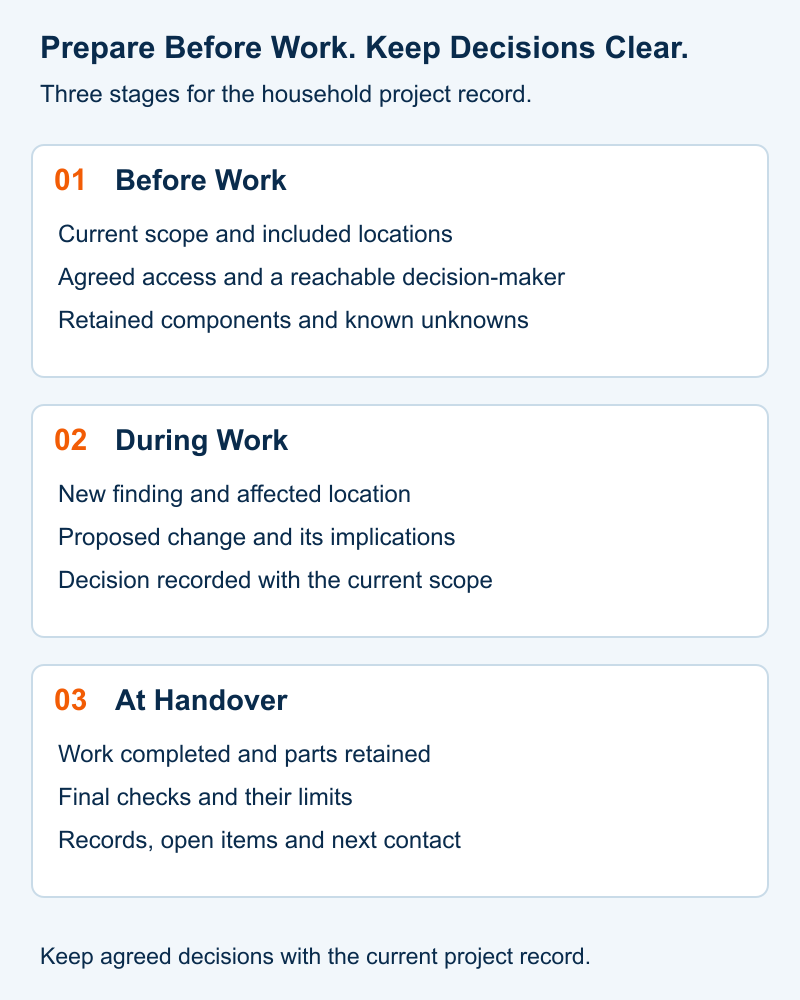
Carry the current scope and later decisions through all three stages.
Confirm the Product Choices That Affect Appearance
Record the material, profile and selected finish before work begins. Keep the actual sample or identifying product information used to make the choice. A color remembered from a screen is not necessarily the same reference as the selected finish.
The Englert catalog notes that printed colors may differ from the actual painted product and recommends obtaining physical color information. Apply the general lesson narrowly: be clear about which reference was accepted, and use the actual supplier's information for the proposed product.
If the scope says “match existing,” identify what that means. It might refer to the visible profile, color, material, route or dimensions. Those are different attributes. Our guide to gutter types separates them so a familiar label does not hide an unresolved choice.
Do not assume a product substitution is equivalent because the color looks similar. Keep any proposed change linked to the original selection and the details that matter to you.
Coordinate Nearby Work Without Assuming One Universal Sequence
Roofing, gutter installation, painting and work around the fascia can share the same area. Tell each party what other work is planned and identify who is responsible for the interfaces. A broad instruction such as “the roofer will handle that” is not a precise boundary.
The right sequence depends on the actual work and retained components. For a roof project, use the roof and gutter coordination guide to keep roof-edge details and handoffs explicit. Do not remove a guard, loosen a gutter or alter flashing yourself to make another task easier.
For ordinary preparation, record the agreed point of contact for each related task, what must be completed before the next step, and who confirms readiness. If no related work is included, keep that fact clear as well.
Plan the Final Review Before the Job Ends
Arrange a way to compare the finished work with the agreed scope and any later changes. The review should be about identified locations and components, not only whether the house looks tidy from the driveway.
Useful review items include:
- Which runs, corners, outlets and downspouts were included.
- Which existing parts remain and what was actually checked.
- The visible water route and any connection still outside the assessed scope.
- Any changed product choice or agreed associated work.
- Removal of materials and cleanup included in the work.
- Product information, applicable written terms and a contact for questions.
- Anything unfinished or still requiring a decision.
PNNL's gutter and downspout guide explains the connection between collection and onward drainage. That is why a handover record should not end at the new channel. It does not mean a visual review proves the capacity or concealed condition of the whole route.
Ask which final checks are included, how they will be carried out and what they can establish. Keep your review at a safe ground-level position; do not climb or try to recreate heavy rain yourself.
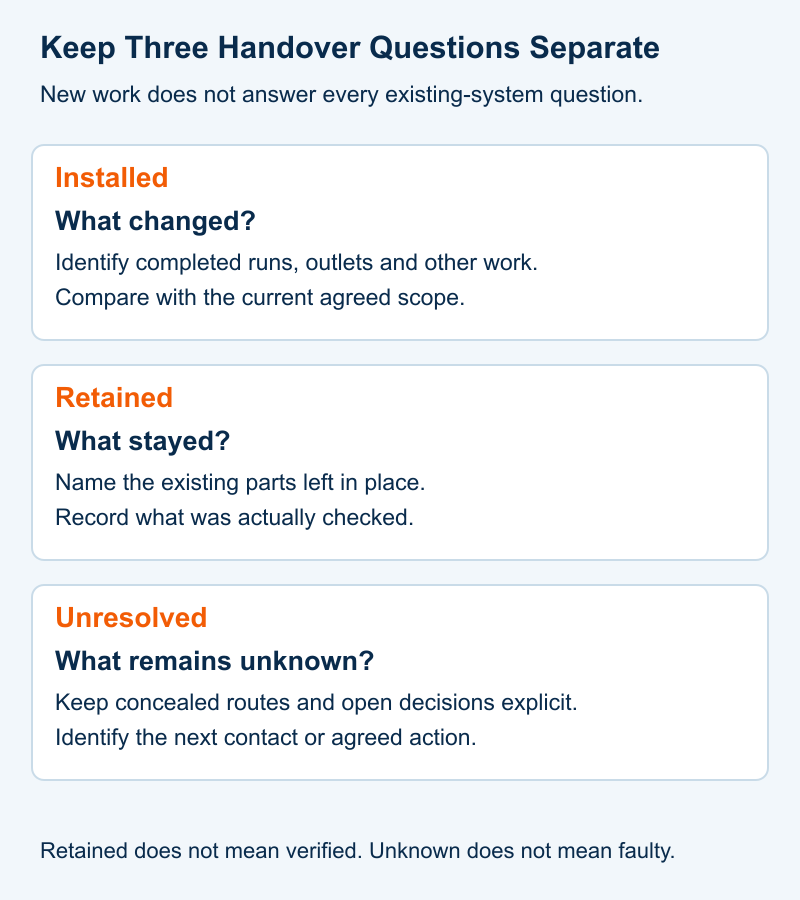
A retained component is different from a verified condition; record what was actually checked.
Keep a Short Preparation Record
Use a dated note with these five headings. Fill it with actual decisions, and leave unknowns visible.
Current scope: proposal version, included locations and later changes.
Access: agreed clear areas, household restrictions and who confirms readiness.
Contacts: work contact, household decision-maker and the method for time-sensitive questions.
Retained parts: what stays, what has been assessed and what remains outside the work.
Handover: final review arrangement, records to receive and any unresolved item.
For example, “rear downspout retained; connected drain destination not verified; no underground work included” is clearer than “drainage checked.” This is a hypothetical record, not a statement about a customer's property or this company's standard scope.
Questions Before Gutter Installation
Should I Clean the Gutters Before Installation?
Do not assume that cleaning or climbing is a homeowner prerequisite. Confirm whether removal, debris handling or cleaning is included in the proposed work and who is responsible. Stay with ordinary, safe household preparation rather than altering the gutter system yourself.
Do I Need to Be Home During the Work?
Agree on access and a reachable decision-maker for your actual project. Confirm whether anyone needs to be present and how questions will be handled if you are away. Record the arrangement and any restrictions before the work begins.
What if a Problem Is Found Behind the Old Gutter?
Use the agreed contact and change-decision route. Keep the finding, its location, the proposed response and any implications together. A concealed condition should not be treated as already resolved or automatically included just because gutter replacement is planned.
Does Gutter Replacement Include New Downspouts?
Only the actual scope establishes that. List which downspouts are new, retained or changed, and identify the onward route separately. A new gutter run does not define the condition or destination of every existing drain connection.
Get Ready for Your Gutter Project
For gutter installation and replacement, bring the current project description, the locations involved and any known access or related-work details. Keep outstanding product choices and unresolved questions visible, and confirm them before the affected work begins.
Contact Atlanta Gutter Specialist about the work you are planning and the questions you want resolved before it begins.
Sources and Review Notes
This guide uses FTC and Georgia consumer guidance for written records, CPSC guidance for the overhead-wire hazard, and PNNL and Englert references for system/component context. The five source links appear where they are relevant. The preparation log and examples are original editorial aids, not legally required forms or a company work procedure. FTC lists July 2022 and PNNL lists September 26, 2021 as its last update. Publication dates were not established for the Georgia consumer page, CPSC document or Englert catalog. Consulted October 26, 2026. Project-specific access, work methods, product instructions and written terms still govern the actual work.