
From the ground, you may notice a dip, a front edge pulling away or a section that looks different from the rest. Those observations are useful, but they do not establish the condition behind the gutter. This guide helps you turn a visible sag into a focused repair discussion without climbing, pulling on the gutter or assuming the whole system needs replacement.
Separate a Dip, a Gap and a Twisted Front Edge
Describe the shape before naming the cause. A low area along the gutter is different from a gap between the gutter and the house. A front edge turned outward is another observation. More than one can be present.
Use a fixed location, such as “the run above the back door,” and describe how much of that run appears affected. Mention whether the change is new, whether water gathers there and whether that area has been repaired before. An existing photo taken from a safe ground position can help show the location; perspective alone cannot measure the installed slope.
Avoid using a roofline, siding joint or camera angle as proof that a gutter is level or out of level. Those references may not establish the gutter's geometry. Keep the observation separate from any measurements made during an assessment.
Follow the Support Chain to the House
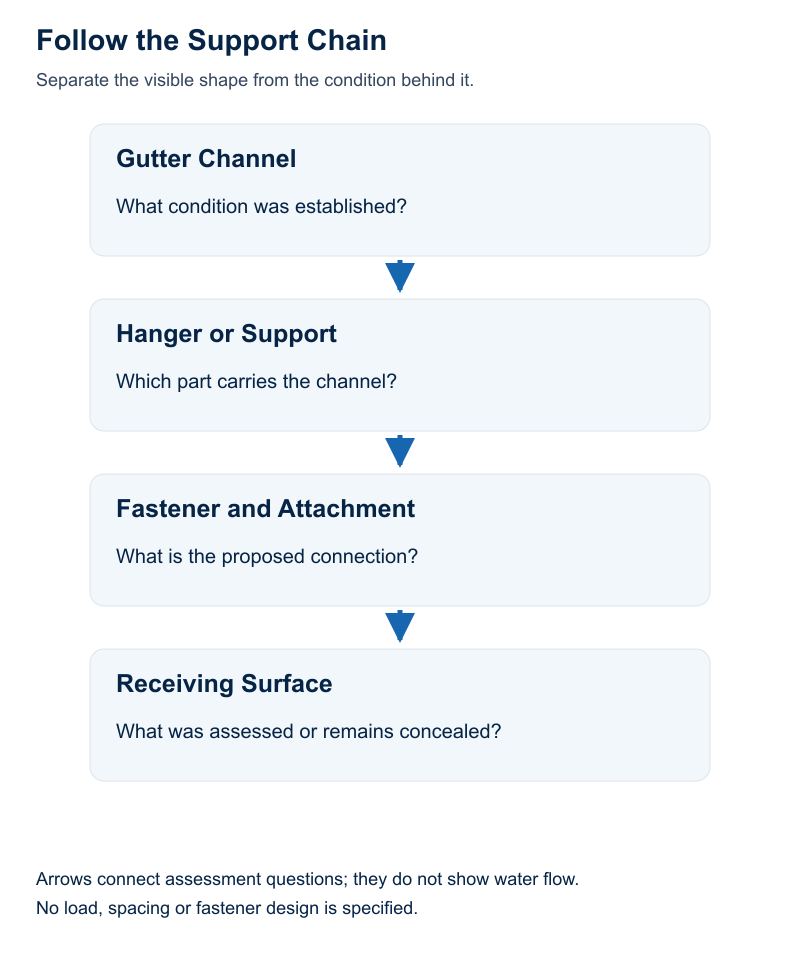
The relevant chain is the gutter, the hardware supporting it and the surface receiving the attachment. A sound-looking outer face does not establish the condition of concealed material. Equally, a stain does not establish hidden decay.
The Standard Work Specifications gutter detail treats attachment, slope and sealing as separate requirements. That separation is useful for evaluating a repair: restoring one function does not document the others. It is a specification resource, not an inspection of your home or a determination of Atlanta code requirements.
Englert's gutter catalog lists different support and connection components. The takeaway is to identify the existing arrangement and the proposed replacement, rather than treat every fastener as the same part.
Ask what was actually found at each point. Is a hanger deformed? Is an attachment loose? Is the channel itself damaged? Was the supporting surface accessible for review? A useful recommendation answers the applicable questions and marks anything concealed or unassessed.
Consider Debris and Water Alongside the Hardware
If debris or retained water is present, identify it separately from the sag. Removing material may be part of the preparation, while restoring support or alignment may require different work. Do not assume cleaning proves that a deformed channel or failed attachment has been corrected.
Likewise, a support repair should not end the discussion of where the water goes. A low area, an outlet restriction and an unknown downspout route are different questions. PNNL's drainage guidance treats collection and onward drainage as a connected system.
Record the distinction in ordinary language: “Debris was removed from this run; the support condition still needs assessment.” That is more informative than marking the gutter simply “done.” For a closer look at retained water, use our standing-water guide.
Understand When the Fascia Becomes Part of the Work
The fascia is an adjoining roof-edge surface, not a synonym for the gutter. If the proposed repair depends on its condition, identify how that condition was established and which area is involved. Do not infer that all fascia needs replacement because one attachment is loose.
If a supporting-surface problem is found, the proposal should distinguish that work from the gutter repair. Identify what would be exposed, repaired or retained, and who would handle the adjoining work. A finding about one area does not establish the condition of the whole roof edge.
Water staining at the back also deserves a separate explanation. GAF's drip-edge bulletin describes roof-edge water direction in its shingle-system context. This is a reason to investigate the water path, not evidence that a particular flashing detail is missing from your home. Our water-behind-the-gutter guide explains that distinction.
Compare the Proposed Changes
A repair might address a limited support problem, a damaged section or a wider arrangement. The useful comparison identifies the finding and connects it to the work. There is no universal hanger-spacing or fastener-size prescription in this homeowner guide.
| Proposed Work | What the Explanation Should Identify | What May Still Need Review |
|---|---|---|
| Renew selected support hardware | The affected location and suitable attachment arrangement | Supporting surface and adjoining hardware |
| Reset a retained run | The geometry being corrected and retained components | Outlet position, connections and water route |
| Replace a damaged section | The extent, joints and matching components | Condition beyond the replaced area |
| Address adjoining support material | The established finding and exact area | Concealed conditions outside the assessed area |
Keep preparation, gutter work and adjoining work distinct even if they are quoted together. Our repair-or-replace guide covers the broader decision when the concern extends beyond one section.
A Worked Example: The Run Above a Porch
Imagine a homeowner reports a dip near the middle of a porch gutter and overflow at the same location. These are hypothetical observations, not a customer project.
“Add two hangers” describes a proposed task. It does not yet explain the condition of the existing hangers, the supporting surface or the shape of the channel. A more useful explanation would identify what was inspected and why the selected work addresses that finding.
For a recurring repair, use the gutter repair mistakes guide to compare the earlier findings, preparation and retained parts with the new recommendation.
If the assessment establishes a localized hardware problem while the surrounding channel and support remain serviceable, a limited repair may be worth considering. If the channel is deformed or the receiving surface cannot hold the proposed attachment, the recommendation may change. Neither conclusion follows from the homeowner's ground-level description alone.
The homeowner can then compare the scope: which parts change, which stay and what remains uncertain. The example is a way to read a recommendation, not an instruction to repair a particular house.
Keep a Short Support-Repair Record
Before agreeing to work, put these details together:
- Location: the run, corner or porch area involved.
- Observed change: dip, separation, twist or another visible condition.
- Established finding: what the assessment actually identified.
- Proposed parts: channel, hangers, fasteners or adjoining support material.
- Retained parts: what stays and whether its condition was assessed.
- Water route: outlet and downspout questions associated with the affected area.
- Remaining limits: concealed areas or separate work not yet resolved.
Afterward, compare the reported work with the same record. Ask what changed if an unexpected condition altered the plan. Do not push, hang from or load the gutter to test the repair yourself.
Common Questions About Sagging Gutters
Does Sagging Mean the Whole Gutter System Must Be Replaced?
Not necessarily. The extent and established condition matter. A limited support issue and widespread damage can lead to different recommendations; a visible dip does not decide between them.
Can I Tell Whether the Fascia Is Sound From a Photo?
A photo can help locate the concern, but it does not establish concealed condition or attachment suitability. Keep those points open until assessed.
Will Cleaning Fix a Sagging Gutter?
Cleaning addresses debris. Whether support, alignment or channel work is also needed depends on the findings. Confirm which of those tasks is included.
Should I Try to Push the Gutter Back Into Place?
Do not try to push it back into place; the channel, attachments and supporting surface need assessment first. Avoid unstable components, climbing and overhead hazards. The CPSC ladder-and-electricity warning is a reminder that gathering information around roof edges can introduce serious risks.
Get Help With the Affected Gutter Run
For gutter repair, start with the location, the visible change and any previous work. Atlanta Gutter Specialist can discuss the concern without you having to diagnose the hardware or choose a replacement system before calling.
Sources and Review Method
This is document-based homeowner guidance, not an engineering design, product prescription or property inspection. The specification and manufacturer examples support separate attachment, geometry and water-path questions; they do not establish universal repair dimensions or this company's inventory. Sources checked October 26, 2026. The support-chain diagram, hypothetical example and repair record are original editorial aids.