
This guide helps you describe the boundary and evaluate a proposed assessment. It does not provide drain-clearing, excavation or disconnection instructions, and it does not assume that buried drainage work is included in a gutter service.
Map the Route in Five Parts
Start at the gutter outlet, then follow the known route through the downspout and any above-ground elbows. Identify where that route connects to an adapter, buried pipe or another receiving arrangement. Finally, record the known destination, if one has been established.
Do not draw a line to the street or a drain merely because it seems likely. A pipe disappearing into the ground is evidence of a connection, not evidence of its destination, condition or ownership. Existing installation records may help, but an old drawing is not proof that nothing has changed.
PNNL's gutter and downspout guide treats onward drainage as part of the water-management route. Its broader design guidance does not establish what is installed beneath an individual property.
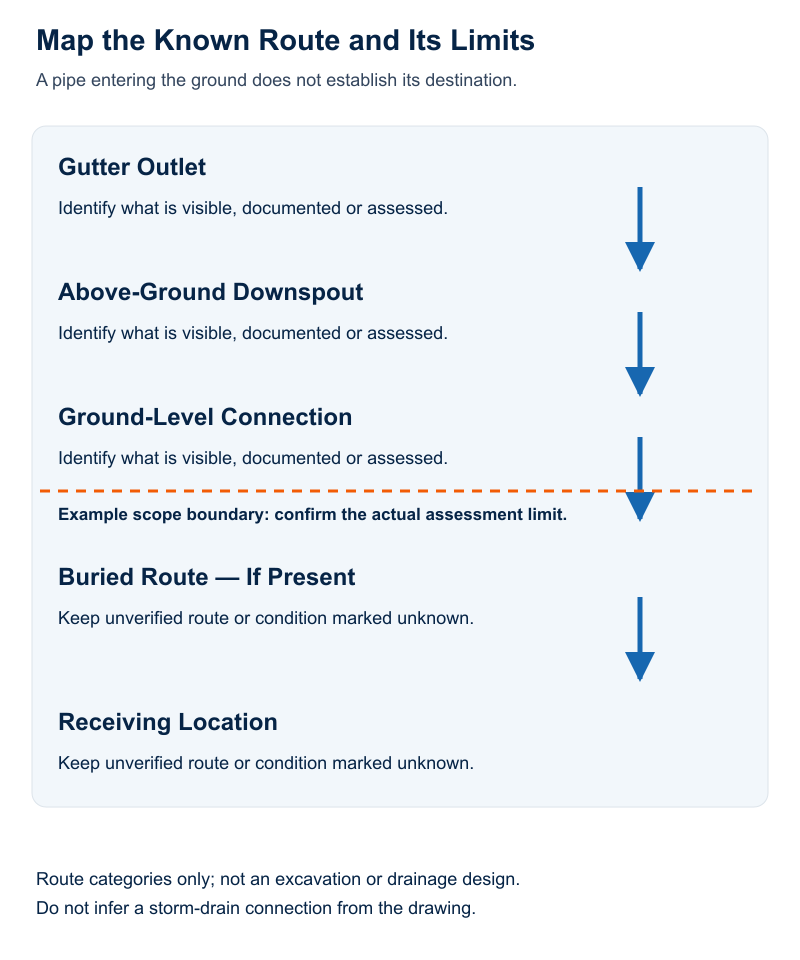
Give each part a status: visible, documented, assessed or unknown. Those labels prevent a useful location sketch from becoming an invented underground plan.
Describe the Symptom Without Guessing the Blockage
Note where water first becomes visible outside the expected route. Is it at the gutter's front, an elbow connection or the ground-level adapter? Does the concern appear during rain, afterward or only under a particular condition you have actually observed?
Water emerging near a ground connection is useful information, but it does not establish the location or cause of a restriction. Similarly, little visible discharge at one outlet does not prove the downspout is blocked. The amount of runoff reaching the route and the receiving arrangement also need context.
Keep earlier work in the record. “Gutter debris removed last month” is different from “the downspout and buried connection were assessed.” If the earlier scope is available, compare what it actually included rather than assume the word cleaning covered every connected component.
Separate Above-Ground Cleaning From Buried-System Assessment
A gutter cleaning proposal can identify specific runs, outlets and downspouts. It should also identify the boundary of any downstream work. The important question is not which trade name appears on the invoice, but which components and activities are actually included.
If a restriction is suspected beyond that boundary, establish what assessment is proposed, what access is needed and who would carry it out. Do not infer that routine gutter cleaning includes buried-pipe diagnosis, drain repair or changes to the receiving area.
Our gutter cleaning scope guide helps compare included work. Our downspout discharge guide covers the different question of where water should go after leaving the roof system.
Identify Access Points Without Opening the System
An access point can affect what assessment is practical, but not every fitting is an access point. Record any known cleanout, inspection record or accessible receiving outlet. Do not open covers, reach into pipes or enter enclosed spaces to complete this record.
NDS's cleanout product information describes cleanouts as access to a drainage pipe system. That is a function of those components, not proof that a particular home's adapter is a cleanout or that its pipe can be assessed from there.
When access is uncertain, a useful proposal names the limit. “Assess the above-ground downspout; buried route not established” is clearer than “check drainage” without a boundary. If further access or separate investigation is needed, keep that as a proposed next step rather than a completed finding.
A Worked Example: Water at the Ground-Level Adapter
Imagine water appears around the connection where a rear downspout enters a buried pipe. The homeowner has a cleaning receipt naming the gutter runs but no underground plan. This is a hypothetical example.
The first record identifies where water appears while leaving the buried route and the cause unverified. A proposed assessment should explain which part of the above-ground system it covers and what it can establish about the connection.
Suppose the above-ground route is assessed but the downstream destination remains unknown. That finding should not be rewritten as “the whole drainage system is clear.” Conversely, an unassessed buried pipe should not automatically be labeled the cause.
The useful outcome is a record of the components assessed, the findings and the unresolved boundary. That makes any separate investigation more focused and avoids paying twice for descriptions that sound broader than the work performed.
Compare the Evidence Behind a Recommendation
| Information Available | What It Helps Establish | What It Does Not Establish Alone |
|---|---|---|
| Ground-level observation during rain | Location and timing of visible water | Exact restriction location or underground destination |
| Earlier cleaning receipt | Work described in that service scope | Condition of every connected pipe |
| Old route drawing | A documented proposed or recorded arrangement | Current condition or unchanged installation |
| Reported assessment findings | Conditions within the stated assessed area | Unassessed adjoining components |
| Known receiving outlet | One identifiable endpoint | The condition of the entire route leading to it |
Ask the recommendation to connect a finding to the proposed work. If the explanation jumps directly from a symptom to replacement of an unknown buried run, clarify what evidence supports that step. This is a request for a clearer explanation, not a conclusion that the work is unnecessary.
Keep Discharge Changes Separate From Clearing
Changing where water goes is a different decision from assessing or clearing an existing route. It can affect the home, neighboring areas and other drainage features. Do not disconnect a pipe or redirect runoff as a diagnostic shortcut.
The NRCS-hosted homeowner drainage guide emphasizes the consequences of runoff routes in its regional educational context. It is not an Atlanta permit decision or a design for your lot. Its role here is to reinforce that the destination deserves assessment rather than improvisation.
If a different receiving arrangement is proposed, identify who will assess it, what existing connections remain and what approvals or property-specific requirements need to be confirmed. Do not assume a gutter-service conversation settles those questions.
A Short Route-and-Findings Record
- Property location: the affected side, corner or porch.
- Visible route: gutter outlet, elbows, downspout and ground connection.
- Observed symptom: where water appears and when.
- Known records: previous work and any route information.
- Assessment boundary: components actually included.
- Findings: what was established within that boundary.
- Unknowns: destination, condition, access or separate work still unresolved.
Keep any report with the same location names. A note such as “rear downspout” is easier to use later when it also identifies the corner and receiving connection. Our after-rain checklist provides a broader ground-level observation record.
Common Questions About Downspout Restrictions
Does a Pipe Entering the Ground Mean It Connects to a Storm Drain?
No. Its destination needs records or assessment. Do not infer a connection from the direction the pipe appears to take.
Does Gutter Cleaning Automatically Include Underground Pipes?
No assumption should be made. Confirm the named components and downstream limit in the actual quote.
Can Water at an Adapter Prove the Buried Pipe Is Blocked?
The location is useful evidence, but it does not by itself establish the cause or exact restriction. Keep observations and assessment findings separate.
Should I Disconnect the Downspout to See What Happens?
This guide does not recommend disconnection or a water test. Identify the known route and ask what assessment is appropriate without changing the discharge arrangement yourself.
Start With the Known Part of the Route
When calling about gutter cleaning or gutter repair, describe the visible symptom and mention any buried connection. Confirm which work can be assessed and what may need a separate service before making arrangements.
Sources and Review Method
Sources checked October 26, 2026. This is document-based guidance on observations and scope boundaries, not a buried-drain diagnosis, excavation procedure or promise of company drainage services. NDS is a component example; PNNL and the NRCS-hosted guide supply broader system context. The route diagram, hypothetical example and findings record are original editorial aids.