
Use this checklist to record visible changes after rain and prepare for a gutter call. Note the location, timing and anything hidden from view. It is separate from a regular cleaning or maintenance schedule.
Wait Until You Can Observe Without Entering a Hazard
Do not go outside to watch an active spill in unsafe weather or stand beneath a loose component for a better view. If the area is not safely accessible from an ordinary ground-level position, leave that part of the record blank and explain why.
Avoid floodwater. The National Weather Service warns against walking or driving into it; the checklist is not a reason to enter water to find an outlet. National Weather Service Flood Safety.
Keep away from overhead wires and do not use a ladder for this record. CPSC specifically warns about electrical hazards when ladders are used for gutter and other exterior work. CPSC Ladder and Electricity Warning.
A photograph is optional. An unavailable view is an honest limitation, not a task you must complete. If a concern involves an immediate hazard, stop the gutter observation; collecting notes can wait.
Give Each Observation a Date and Location
Begin with a short event record. Separate what you noticed during rain from what remains visible afterward. Do not describe a dry visit as though you observed the system carrying water.
| Record | Useful Detail |
|---|---|
| Date and approximate time | When you noticed the concern, not a guessed weather measurement |
| Location | Wall, corner, roof section or downspout in ordinary language |
| Observation timing | During rain from a safe position, afterward, or learned from an existing record |
| Visible condition | What you can actually describe |
| Previous condition | Earlier dated photograph or note, if available |
| Visibility limit | Covered channel, hidden connection or inaccessible area |
Avoid assigning an exact rainfall intensity from appearance. “I noticed it during heavier rain” records your observation; it is not a measured storm or a design input. If an earlier condition is unknown, write that rather than calling the change new.
A repeatable location description helps when several runs or downspouts are involved. Give each location its own entry so different symptoms do not become one general “gutters failed” conclusion.
Look at the Run Without Standing Beneath a Concern
From a safe position, note any visible change in the gutter line, separation at a connection or component that appears out of place. Describe the location and appearance without pulling, straightening or testing anything.
Portland's stormwater-maintenance guidance identifies low or sagging gutter areas and downspout connections as maintenance concerns. These are useful categories for a conversation, not Portland repair instructions or rules to apply to an Atlanta home. Portland Stormwater Maintenance Guidance.
If you cannot see the whole run, say which part is outside the view. A photograph of one corner does not document every attachment or the interior of the channel. Likewise, a continuous-looking line from the ground does not certify the condition of concealed components.
Keep a visible change separate from its presumed cause. “The rear connection appears separated in this view” is more useful than “the storm broke the gutter,” unless the cause has actually been established.
Distinguish Where Water Left Its Path
Use the most precise description available. You may have noticed more than one water path:
| Observation | Record Without Assuming |
|---|---|
| Water crossed the front lip | Which run or corner, and when it happened |
| Water appeared behind the gutter | Which roof-edge location was involved |
| A joint or end dripped | Whether the observation was at that connection |
| Water appeared around a downspout connection | The visible location and known connected route |
| A mark remained afterward | The mark's location, without calling it proof of a leak's cause |
The overflow-after-cleaning guide explains possible assessment questions for recurring spills. The water-behind-the-gutter guide covers roof-edge and roof-wall interfaces. Use the observations to choose the next question, rather than using an article to diagnose an unseen component.
If you did not see water moving, record the residual sign as a residual sign. A wet patch or stain may be worth discussing, but it is different evidence from seeing the point where water crossed an edge.
Follow the Visible Downspout Route
Note where the downspout goes and whether the visible parts appear different from an earlier record. Does an extension remain where you last recorded it? Is a connection visible, or does the route disappear into the ground? Keep an unknown destination unknown.
PNNL treats gutters and downspouts as parts of a water-management route that carries roof runoff away from the home. That wider relationship supports looking beyond the roof edge, without applying the source's program-specific dimensions or designing a receiving area yourself. PNNL Gutters and Downspouts Guide.
Do not move an extension, open a connection or pour water into a pipe to fill a gap in the record. Those actions can change the condition you wanted assessed. Ask what investigation is appropriate and which connected components would be included.
The downspout-discharge guide helps distinguish conveyance from the receiving point. A pipe entering the ground is not evidence that its destination has been identified or assessed.
Note the Receiving Area and What Changed
From a safe position, record visible pooling, displaced material or a changed surface near the receiving location. Include the timing and any earlier record. Avoid concluding that the gutter caused a ground-level condition solely because both were noticed after rain.
Portland's guidance discusses receiving-area erosion, changes and overflow routes. Those categories can help organize observations, but its facility-specific timing, setback and maintenance rules are not an Atlanta diagnosis or a prescription for your yard.
Do not wait for an arbitrary interval from another city's guide to decide whether an unknown condition is acceptable. Ask how the actual receiving route should be assessed. Do not enter a drainage structure, dig around a connection or alter the landscape to test an explanation.
If a receiving area is outside your safe view or belongs to another property, record the limitation. The useful question is what is known about the route, not how much of it you can investigate yourself.
Take Photos Only if Safely Available
A small set of well-described photographs can locate a concern better than many unlabelled close-ups. Use ordinary safe positions; do not trade a safer view for a closer one.
- Whole run or wall: show the relevant section and an identifiable corner or downspout.
- Visible trouble spot: show the joint, mark or edge involved without assuming it establishes the cause.
- Receiving route: show the visible downspout end or connection and its surroundings, if accessible.
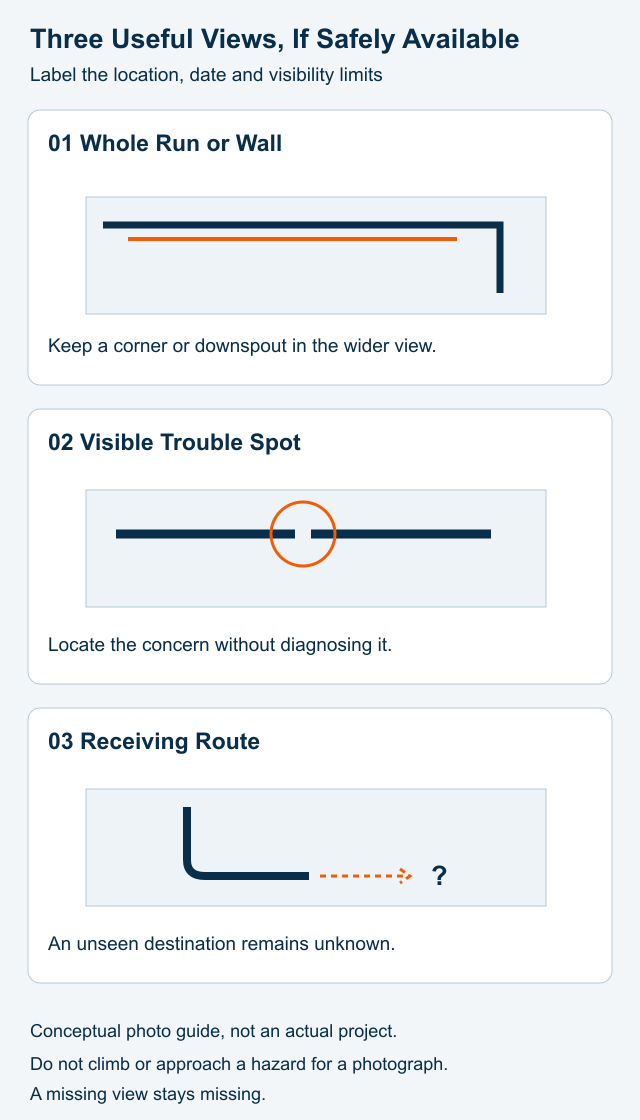
Original photo-planning illustration. It is not a storm-damage project or an instruction to approach a hazard. A missing view stays missing.
Label photographs with location and date. Note whether water was moving at the time or the image was taken later. Keep the original image with your notes rather than relying only on a crop that removes the surrounding context.
Note Previous Cleaning and Repairs
If the area was recently cleaned, repaired or replaced, keep the written scope and date with the new observation. Identify which components that work actually included. Do not turn “cleaning was done” into confirmation that every downspout or connected pipe was checked.
If the symptom returned, record the new date and location rather than assuming it has the same cause. Ask how the earlier finding and current observation relate. The next step may be a discussion about an unassessed part of the route, not automatically another cleaning or full replacement.
For ongoing reminders and work history, use the Atlanta gutter-maintenance guide. This checklist captures an event; the maintenance log keeps the longer record.
Use a Dated Observation Sheet
Open the After-Rain Worksheet, or keep one entry for each location:
| Field | What to Keep |
|---|---|
| Event and observation date | Separate approximate timing from measured weather data |
| Location and water path | Describe the visible symptom |
| Before/after reference | Existing note or photograph; otherwise unknown |
| Receiving route | Visible destination and hidden or unassessed sections |
| Photograph reference | Whole view, trouble spot and receiving view if available |
| Earlier work | Date and actual included scope |
| Next question | Finding to discuss, not a preselected repair |
A hypothetical entry might read: “Rear-right downspout, photographed after rain on this date. Water is no longer moving. The visible extension appears displaced compared with my earlier photo; the receiving destination is not established.” This records a change without diagnosing the reason or prescribing how to reposition it.
Describe the Changes You Noticed
For an existing concern, see gutter repair. If the discussion concerns debris maintenance, see gutter cleaning. Bring the observation date, location, any safely available photographs and the scope of recent work.
Contact Atlanta Gutter Specialist to discuss what you noticed. A clear description is useful even when the cause and appropriate work are still to be established.
Sources and Method
Research checked October 26, 2026. PNNL's guide was updated September 26, 2021. Publication dates were not verified for the Portland and NWS pages; CPSC Publication5060 carries code042012. The checklist and illustration organize observations, not an inspection, emergency response, storm-causation finding or insurance determination.