
The University of Georgia’s home-maintenance checklist organizes evaluations around spring and fall. Its gutter and downspout entry includes cleaning and explicitly notes that cleaning may be needed more frequently. The distinction matters: a calendar can remind you to evaluate the system, but it cannot establish how much debris is inside a particular gutter today. UGA home-maintenance checklist
This guide helps you keep a useful record, recognize the limits of observations from the ground and discuss an appropriate maintenance plan. It does not diagnose a gutter problem or prescribe a service interval for an unseen property.
Separate the Reminder, the Finding and the Work
Three dates can describe three different things:
| Record | What it tells you | What it does not establish |
|---|---|---|
| Evaluation reminder | It is time to review maintenance needs. | That cleaning is automatically necessary or sufficient. |
| Observation or assessment | Someone recorded a visible condition or assessed an accessible part of the system. | That every hidden outlet, downspout or buried route was checked. |
| Cleaning performed | A defined maintenance task was completed. | That every later overflow has the same cause or that future maintenance is unnecessary. |
Keeping these entries separate makes a maintenance history more useful than a series of invoices labeled simply “gutters.” If a visit only addressed one roof section, the record should not imply that all sections and downstream components were assessed.
Use the calendar as a reminder, then record what was found and which parts were checked. The next cleaning decision should reflect that history and any changes at your home.
Why a Fall Cleaning Does Not Settle the Next Season
UGA’s March 2023 maintenance newsletter points out that gutters may contain leaves and twigs that accumulated over winter even if they were cleaned in fall. That is a reason to revisit conditions, not a prediction that every property will have the same debris at the same time. UGA Healthy Indoor Environments, March 2023, page 3
Avoid building a plan around an assumed local tree calendar. Record what is present at your property instead. If you can safely see debris from an ordinary ground-level position, note its location. If the channel is hidden, write “interior not visible,” rather than “clear.” A tree near the house can be relevant context, but its presence alone does not establish how frequently a particular run needs cleaning.
A useful history can include observations made between seasonal reminders. A newly noticed change in water flow, visible accumulation or a change to the roof or surrounding conditions is information to discuss. It does not automatically authorize work, establish a diagnosis or mean that every storm requires a cleaning visit. Make observations only when conditions are safe; do not approach a hazardous area to complete a log.
What You Can Record Without Climbing
From a safe, ordinary ground-level position, write down the location and what you actually noticed. Keep the wording descriptive:
- “Water came over the front edge above the porch” is more useful than “gutters too small.”
- “Material visible on the guard surface near the corner” is more precise than “guards blocked.”
- “Downspout enters the ground; destination not known” preserves an important uncertainty.
- “Channel cannot be seen from here” is a valid finding, not a failed inspection.
These are examples of wording, not observations from your home. A photograph taken safely from the ground may help identify the location later. Do not lean out of a window, climb onto a roof or use a ladder to complete this worksheet. The Consumer Product Safety Commission warns about the electrocution hazard when ladders contact overhead wires, including during gutter work. The log is not a ladder-safety procedure. CPSC ladder and electricity warning
An absence of visible debris does not establish that an outlet or enclosed downspout is clear. Equally, visible material does not tell you the full extent of the work required. Ask what can be assessed safely and what access or expertise is needed before interpreting the observation.
Cleaning Frequency and Gutter Condition Are Different Questions
A maintenance visit and a repair assessment can overlap, but they answer different questions. One concerns material that needs removing and the agreed cleaning scope. The other concerns the system’s condition and water path.
If water still appears in an unexpected place after cleaning, do not simply shorten the interval and assume that resolves the cause. Record where it happened, what work was previously completed and which components remain unassessed. Our guide to gutters overflowing after cleaning explains how to organize that conversation without jumping to a diagnosis.
Likewise, a downspout disappearing into the ground is not evidence that its receiving route is suitable or working. If the destination is unknown, retain that uncertainty in the maintenance record. The downspout-discharge guide separates the visible outlet, conveyance route and receiving area. It does not turn an observation into a drainage design.
The purpose of a maintenance history is to make these distinctions easier. Repeated entries at one location can help frame an assessment; they do not independently prove a cause or justify replacing an entire system.
Do Gutter Guards Remove the Need for Checks?
Do not erase maintenance reminders simply because guards are installed. Establish what product is present and obtain its actual care instructions. A guard surface, the gutter channel underneath and downstream components are different areas; a visit may not include all of them.
As one limited manufacturer example, Gutterglove acknowledges routine maintenance and attention to debris on top of guards in its installer-question guidance. That commercial source is not independent proof of every guard’s performance or a universal care schedule. We are not adopting its broader product claims or recommending a particular product. Gutterglove installer questions, maintenance section
Useful questions include:
- Which product’s care instructions apply, and where can I keep a copy?
- Does the proposed work address the surface, the gutter interior or both?
- What access or removal is needed, and is it included?
- Which outlets and downstream components will be assessed?
- What remains unknown after the visit?
For a discussion of fit and maintenance considerations, see gutter guards. Use the care instructions for the actual product and ask how the condition of your gutters affects the maintenance plan.
Use a Dated Log to Build a Property-Specific History
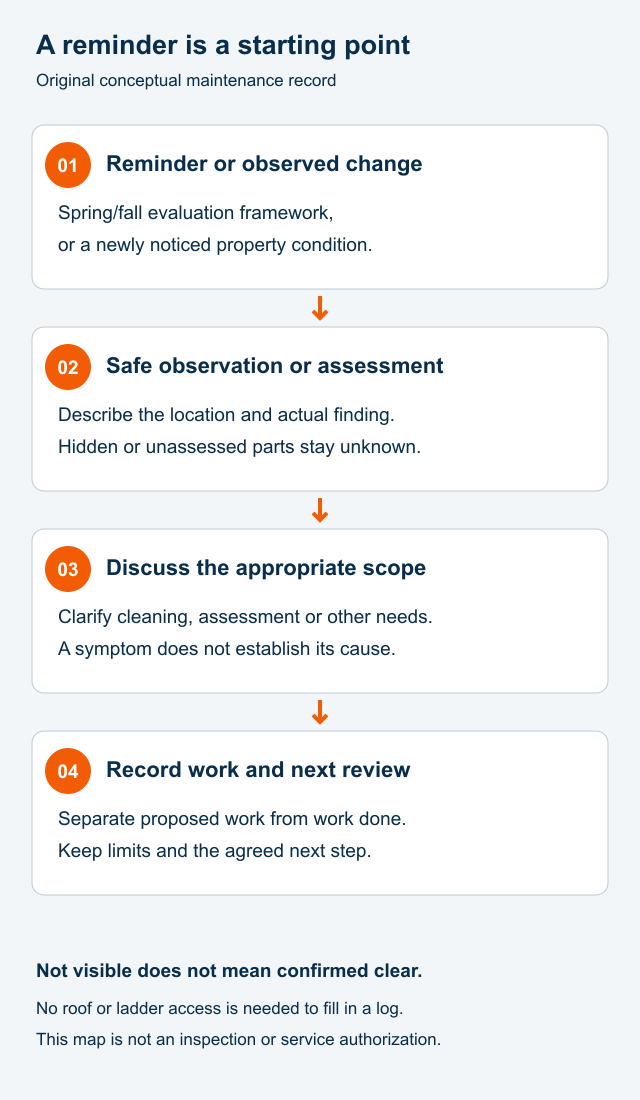
Conceptual maintenance framework. It organizes questions; it does not set a cleaning interval or diagnose a defect.
Start a blank record rather than reconstructing a confident history from memory. If an older date or scope is uncertain, label it uncertain. Keep invoices and written scopes alongside the log so a future reader can distinguish what was requested from what was actually recorded as completed.
Open the printable gutter-maintenance log. It collects:
- Date and reason for the entry. A seasonal reminder, a newly noticed change, an assessment or completed work.
- Location and observation. Identify the roof section or outlet in ordinary language; describe only what is known.
- Visibility and assessment limits. Record hidden channels, inaccessible sections and unknown downstream routes.
- Agreed and completed scope. Keep work proposed separate from work performed, including any components retained or not assessed.
- Remaining concern and next review. Record who should clarify the issue and any agreed reminder date or trigger.
The last field is deliberately open. It should capture an agreed plan or a question to resolve, not impose a universal interval. If there is a concern and the condition is unknown, the next step may be an assessment discussion rather than waiting for the next seasonal reminder. A blank log is not evidence that the system has been inspected.
Check What Each Maintenance Visit Includes
Ask what a proposed cleaning visit includes. “Gutter cleaning” alone may leave questions about which runs, outlets, downspouts, guard surfaces, access arrangements and cleanup are included. Use these questions to compare what each visit would include and clarify any work left out.
Ask how findings and exclusions will be recorded. If a component cannot be assessed, the written record should make that limit understandable. If additional work is recommended, request a clear explanation of the observed condition and proposed scope rather than treating the recommendation as already approved.
The FTC recommends comparing written home-improvement estimates and clarifying differences in work, materials and price. Apply that comparison principle to the specific work under discussion; do not assume that a lower price or a more frequent visit schedule means equivalent scope. Confirm the proposed price, payment terms and any applicable warranty details in writing. FTC home-improvement consumer guidance
Questions Homeowners Often Ask
Is Twice a Year Enough for Atlanta Gutters?
Not necessarily. Cleaning depends on the debris and conditions found at your home. UGA’s spring/fall reminders are evaluation points, and its checklist notes that cleaning may be needed more often. Keep records of what was checked and what work was done.
Should I Book Cleaning After Every Storm?
This guide does not prescribe that. Record a newly noticed change only when it is safe to do so, and discuss whether it calls for cleaning, assessment or another response. A weather event alone is not a recorded finding about your gutters.
If I Cannot See Leaves, Can I Skip the Check?
A ground view may not reveal the channel or enclosed components. Record what is not visible and ask how the relevant parts can be assessed. Do not turn “not seen” into “confirmed clear.”
What If the Same Problem Returns Soon After Cleaning?
Keep the location, previous scope and subsequent observation together. Discuss the condition and water path rather than assuming that more frequent cleaning is the only answer. The overflow guide linked above gives a more detailed question framework.
Use Your Records When Arranging Gutter Cleaning
For gutter cleaning in Atlanta, bring the last known service date, the location of any concern and notes about what was previously assessed. If those details are unknown, say so. A useful conversation can start with uncertainty; it should not replace it with a guessed schedule.
Contact Atlanta Gutter Specialist to discuss the condition you have noticed and the appropriate next step.
Source Context: Sources checked October 25, 2026. UGA C1082 received full review March 1, 2023; the newsletter is dated March 2023. Manufacturer guidance is commercial and product-specific.
To record a specific event, use the after-rain gutter and downspout checklist alongside this longer maintenance log.