
Identify the guard and find its care instructions. Then separate the work into three areas: the cover, the gutter beneath it, and the outlets and downspouts. This helps you compare what a maintenance visit will actually cover.
Start With the Product’s Care Instructions
As one concrete example, Gutter Guard by Gutterglove's installation guide includes a maintenance section on printed page 17. It calls for periodic checks for debris, particularly around roof valleys and areas sheltered from wind, and describes surface care for that product. That is a manufacturer acknowledging continuing maintenance, not independent evidence that every guard behaves the same way. Gutter Guard by Gutterglove guide, maintenance section.
For your home, ask for the instructions that match the installed product and version. A brand name on an old invoice may be a starting point, but it may not identify the model or installation arrangement. If the product cannot be established, record that uncertainty instead of substituting another manufacturer's care method.
Keep the instructions with the installation scope and subsequent maintenance records. They provide a reference when discussing permitted cleaning methods, access, removal and any applicable terms. This guide does not recommend a particular guard, brush, cleaner or installation method.
If you are still choosing a cover, first compare mesh and solid gutter guard arrangements. Product selection and ongoing care answer different questions; keep the selected product’s instructions with the maintenance record.
Separate the Cover From the Water Route
“Clean the guards” can mean different things to different people. Before comparing work, distinguish the areas involved:
| Area | Question to resolve | What a limited observation leaves unknown |
|---|---|---|
| Guard surface | What debris is present, and what care does this product allow? | Whether the channel below is clear |
| Gutter channel | Is the interior included in the assessment or cleaning scope? | Its condition when the cover prevents a view |
| Outlet and downspout | Which exits and connected sections will be assessed? | Whether water can travel through unexamined sections |
| Receiving route | Where does water go beyond the downspout? | The destination or condition of a hidden connection |
This is a way to organize the scope, not a diagnosis or a requirement to dismantle the system. Some parts may be visible; others may need a different access arrangement or remain outside the proposed work. An honest record distinguishes them.
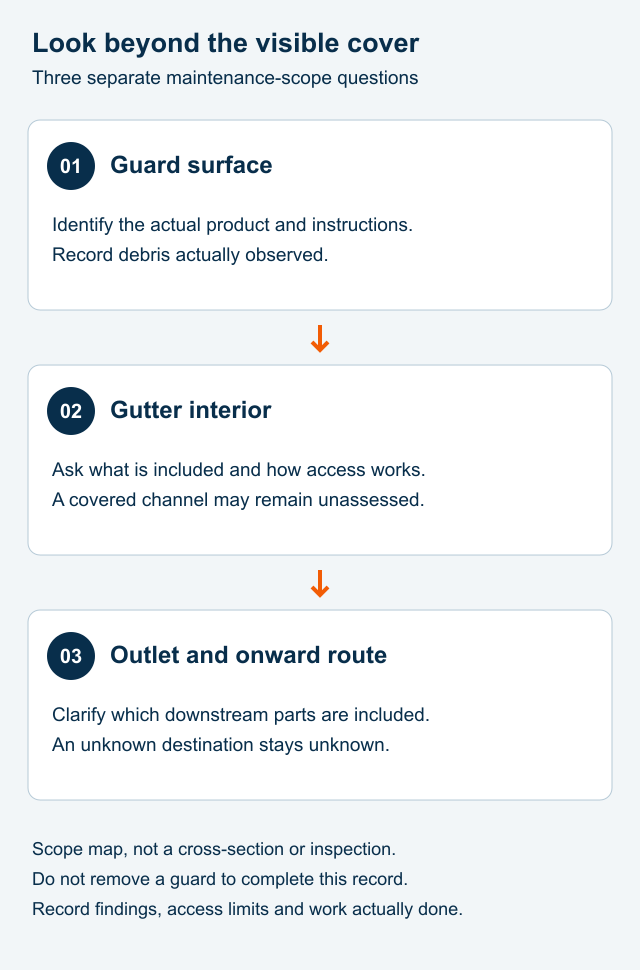
Conceptual scope diagram. The three areas are questions to clarify, not a product cross-section or instructions to remove a guard. Hidden components remain unknown until assessed.
A surface-only visit should be described that way. Likewise, an invoice saying “gutters cleaned” should not be interpreted as evidence that a buried connection was investigated unless the scope actually records that work. The downspout route guide explains why a visible pipe connection does not establish its destination.
Leaves, Needles and Fine Debris: Ask About the Actual Finding
Avoid choosing a maintenance plan from a list of debris that a product supposedly blocks. Record what has actually been observed at the affected run, then compare that finding with the product instructions and the proposed work.
Useful notes might describe leaves resting on the cover, small material visible at an opening, or a section that cannot be seen from the ground. “There are pine trees nearby” and “pine needles were found inside this run” are different statements. The first is context; the second needs an actual observation or assessment record.
The same distinction applies to roof granules, pollen and other fine material. Do not assume that their presence identifies a failed product, a blocked outlet or a roof defect. Ask what was found, where it was found and how it affects the maintenance recommendation. This guide does not rank mesh sizes or claim that one material excludes every type of debris.
If someone recommends changing the guard, request the reason for that change rather than treating any visible accumulation as proof that the whole system needs replacement. The condition of the cover, channel, attachments and water route are separate questions to establish.
Clarify Access Before Agreeing to Work
Ask how the relevant areas can be assessed and what the proposed visit includes. If removal is proposed, clarify who will remove and reinstall the product, which sections are involved and which instructions apply. Do not remove or bend a guard simply to complete this article's worksheet.
Write down any limitation that changes the scope. An inaccessible run, an unidentified product and a covered outlet are different unknowns. A useful proposal explains whether those questions will be resolved during the visit or remain excluded.
Also distinguish cleaning from alterations. Changing the cover arrangement, roof-edge interface or outlet is a different scope from clearing surface debris. Ask what finding supports the change and whether additional work requires a separate discussion. None of these questions implies that a particular task is included in Atlanta Gutter Specialist's services.
Protect the Roof-Edge Relationship
A guard can meet roofing, flashing or other roof-edge materials. Care or replacement should account for that interface instead of focusing only on the exposed top surface.
GAF's gutter-cover bulletin discusses following installation instructions and avoiding practices that disturb certain roofing details. It also distinguishes its shingle warranty from gutter-cover products and installation damage. This is GAF-specific guidance, not a statement that installing guards automatically voids a roof warranty. GAF TAB-R-113: gutter covers and shingles.
For a proposed alteration, ask which roof or guard instructions apply, whether the work changes an existing interface, and who will assess that relationship. Obtain the actual applicable terms rather than relying on a generic verbal promise about “the warranty.” This article does not interpret coverage for your property or prescribe a repair detail.
What If Water Still Spills With Guards Installed?
Record the location and water path before deciding that the guard is the cause. Is water crossing the front edge, appearing behind the gutter, leaking at a joint or emerging near a downspout connection? Those descriptions frame different assessment questions.
A surface that looks clear from below does not establish that every channel and outlet is clear. Equally, debris visible on a cover does not prove that it explains every spill. Keep the finding separate from the conclusion.
If the symptom returns after maintenance, keep the previous scope beside the new observation. Ask which parts were addressed, what was left unassessed and how the proposed next step relates to the symptom. The overflow-after-cleaning guide explores this assessment framework in more detail; a repeated cleaning order is not a substitute for identifying the relevant water path.
Record the Guard Product and Maintenance Included
Open the guard-maintenance worksheet, or use these fields when discussing the work:
| Record | What to write down |
|---|---|
| Product reference | Known brand/model, instruction copy, or “not established” |
| Location | Wall, run or roof section involved |
| Finding | What was actually observed, by whom and when |
| Surface scope | Care proposed for the exposed guard |
| Interior and outlets | What will be assessed or cleaned, and how access is addressed |
| Downstream route | Sections included and connections still unknown |
| Changes | Any removal, reinstallation or alteration proposed |
| Completion | Work actually recorded as done, limitations and next question |
Leave an unknown explicit. A blank row does not mean that the component is clear, serviceable or included. Keep proposed work separate from completed work so the next conversation starts from a reliable record.
Questions Homeowners Often Ask
Does a Guard Mean I Can Cancel Maintenance Reminders?
Use the actual product instructions and property findings to discuss ongoing care. This guide supplies no universal interval or maintenance-free guarantee. The Atlanta gutter-maintenance guide covers reminders and a dated history without assuming one schedule fits every home.
Is Cleaning the Top the Same as Cleaning the Gutter?
They describe different areas. Ask what the work includes and whether the channel, outlets and downspouts will be assessed. Do not infer a hidden component's condition from the appearance of the cover.
Must Every Guard Be Removed for Cleaning?
That cannot be decided from the word “guard.” The product, access arrangement and proposed work matter. Ask which instructions govern the task and whether removal and reinstallation are included; this article gives no removal procedure.
Should I Climb up to Identify the Product?
No climbing is needed to complete this record. Start with invoices, installation documents and safely available observations. CPSC warns about electrical hazards during ladder work, including gutter work. Do not approach wires or climb to fill in missing information. CPSC ladder and electricity warning.
Discuss the Guard and the System Together
Explore gutter guards for fit and maintenance considerations, or gutter cleaning when discussing maintenance needs. Bring the product information you have and the location of any concern.
Contact Atlanta Gutter Specialist to discuss your gutters. Tell us where water spills or debris collects, and mention any guard product information you have.
Sources and Method
Research checked October 26, 2026. Manufacturer guidance is product-specific and commercial; the downloadable guard guide's publication date was not verified. GAF's bulletin carries revision code01252021.