
Two quotes can both say “gutter guards” while proposing quite different work. One may cover only selected runs; another may include preparation or replacement gutters. A product comparison is most useful when those differences are visible. Start with the named product and the parts of your home it would cover, then work through the questions below.
Mesh and Solid Describe Water Entry, Not a Complete System
Think of the guard as an entry point rather than the whole drainage system. Water that enters still needs a route through the gutter, outlet and downspout. A cover choice does not establish the condition or capacity of those retained parts. PNNL’s Gutters and Downspouts guidance treats collection and onward drainage together.
The useful distinction is where water is meant to enter. A mesh surface has many openings. A curved solid cover presents a different entry route, typically around its nose or through a channel near the front. “Solid” does not mean a sealed lid with no inlet.
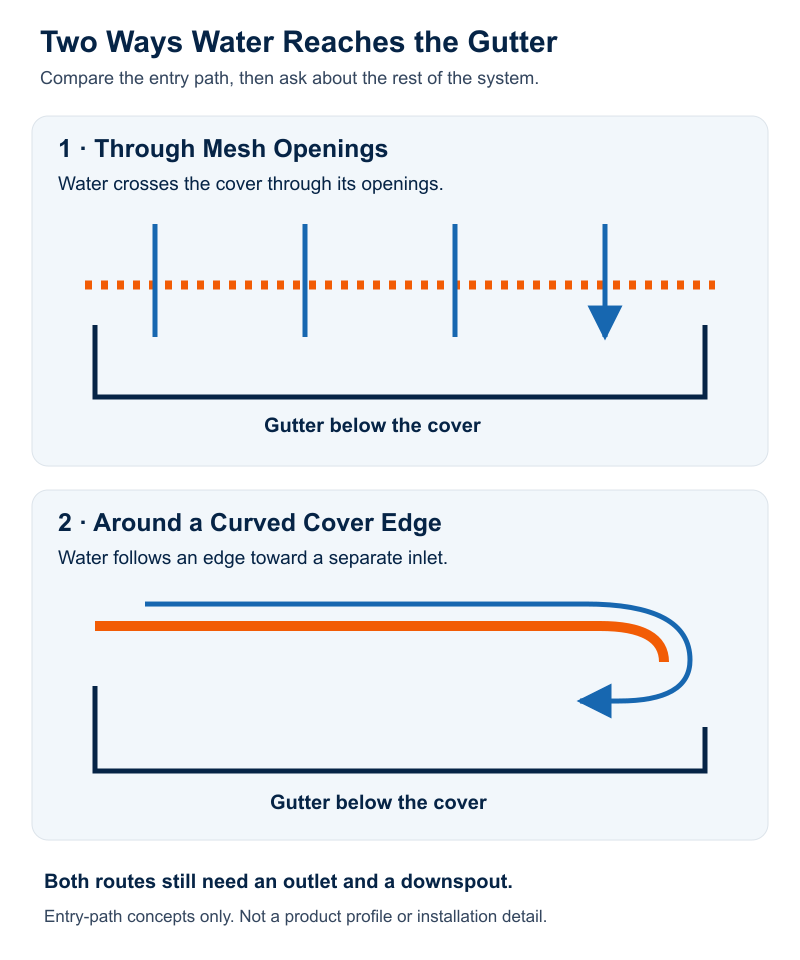
Keep product names alongside category labels. “Micro-mesh” does not identify the frame, attachment or roof detail. “Solid cover” does not tell you its material, opening arrangement or removal method. Ask for the model and the instructions that apply to that exact version, rather than relying on a sample that merely looks similar.
What Two Manufacturer Documents Actually Show
The following examples show how to read a proposal, not which brand to buy. They do not identify products supplied by Atlanta Gutter Specialist.
The Raptor stainless steel micro-mesh installation guide describes alternative roof-edge arrangements. It warns against lifting roofing adhered to the underlayment and against raising shingles out of position. Its maintenance section calls for periodic inspection and surface-debris removal, particularly at valleys and wind-sheltered areas.
The Amerimax Solid Gutter Cover sheet describes a rigid PVC cover with water passing around the nose into a slotted channel. Its illustrated arrangement goes beneath shingles and engages the gutter’s front edge. Corners and concentrated flow receive separate attention. The sheet does not provide a comparable routine-care schedule; that omission is a question to resolve, not evidence that care is unnecessary.
Neither document supplies an independent, like-for-like test proving its category is best for every Atlanta home. Treat broad performance language as a manufacturer claim until you understand the test conditions and relevance to the proposed installation.
Compare the Roof Interface Before the Surface
Ask the person preparing the quote to identify the back and front attachment locations. Would the guard sit beneath roofing, attach below the roof edge or use another documented arrangement? Which existing parts must be moved, fastened through or retained?
This is especially useful when roof work is planned. “The guards can stay” leaves several decisions unanswered: can the roofer reach the edge, who removes and refits affected sections, and what happens if the replacement roof detail differs? Put those responsibilities beside the proposed work. Our roof and gutter coordination guide covers that broader sequence.
Do not lift shingles or remove a cover to answer these questions yourself. Existing ground-level photographs, paperwork and an assessment can establish what needs a closer look. If the attachment method is not yet determined, record it as unresolved instead of treating it as included and settled.
Match the Comparison to the Debris You Actually Notice
Make a short observation list: broad leaves, needles, fine material or debris gathered at a particular corner. Identify where you have noticed it. You do not need to name every tree or estimate an annual volume.
Then ask each proposal to address the same observations. What is expected to remain on the surface? What might reach the interior? How would a buildup be recognized and reached? A claim about stopping large leaves does not answer a question about fine material or access beneath the cover.
Keep the evidence comparable. A demonstration with clean water is different from information about a specific roof edge with accumulated debris. Ask what a test measured, which product and installation it used, and what it does not establish. A persuasive demonstration should not replace the property-specific questions.
Treat Valleys and Existing Overflow as Separate Questions
Mark any roof valley, upper-roof discharge or corner where you have noticed concentrated water. Ask how that location appears in the proposed layout. Do not assume every run can use an identical detail merely because the same guard is specified throughout.
If water already spills over, describe whether it appears at the front, behind the gutter or near a downspout. Those are useful observations, not diagnoses. Avoid choosing a cover solely because a salesperson attributes every symptom to leaves.
The first decision may be whether the current system needs a separate assessment or repair. Our overflow-after-cleaning guide explains why another cleaning or a new cover may not answer every water-path question. Gutter repair and guard installation should be distinguished in the proposed work even when they are included in one quote.
Compare Three Kinds of Maintenance Access
Ask about the visible surface, the gutter beneath it and the outlet beyond it. These are different places, and “easy to clean” does not say which one is accessible.
- Surface: What instructions apply to material lying on the cover?
- Interior: How can someone inspect or reach debris beneath it?
- Outlet: How can a restriction at the gutter-to-downspout connection be investigated?
Identify any removal and reinstallation involved. Ask who can do that work and whether product-specific procedures or replacement pieces are needed. A removable section is only useful if its location and access method are known when needed.
Keep the care instructions with the estimate and final product record. Do not assume a category name determines the maintenance interval. Our gutter guard cleaning guide goes deeper into surface, interior and outlet scope.
When arranging gutter cleaning, identify which of those areas the proposed visit includes. The cleaning quotation guide separates checks, clearing, access and cleanup without assuming removal or refitting is included.
Use the Same Comparison Record for Both Quotes
Fill in this record from the proposal and supplied documents. Leave unanswered items marked “not confirmed.” A blank should prompt a question, not an assumption that the work is excluded or that a product cannot do it.
| Detail | Proposal A | Proposal B |
|---|---|---|
| Exact product, model and document version | Record the supplied name and instructions | Record the supplied name and instructions |
| Gutter runs included and retained | Identify each roof or porch area | Identify each roof or porch area |
| Roof-edge and front attachment | Record the proposed arrangement | Record the proposed arrangement |
| Preparation and existing problems | Separate included, conditional and unresolved work | Separate included, conditional and unresolved work |
| Valleys, corners and concentrated water | Identify the location and proposed detail | Identify the location and proposed detail |
| Surface, interior and outlet access | Record access and removal arrangements | Record access and removal arrangements |
| Care information and written coverage | Keep the applicable documents | Keep the applicable documents |
Compare the whole package rather than a price per foot alone. Different included runs, preparation, access and retained components can make two totals describe different jobs. Compare prices for the actual products and included work rather than assuming a fixed price difference between mesh and solid systems.
If coverage is offered, obtain its written terms and distinguish the product from installation or other work. This guide does not interpret a warranty or promise coverage. Ask the provider about anything unclear before relying on it.
Common Questions About Mesh and Solid Guards
Are Micro-Mesh Guards Always Better for Pine Needles?
Do not choose from the label alone. Ask for the specific product’s information about the debris you notice, its installed arrangement and future access. This guide has not independently tested products or ranked their performance.
Does a Solid Cover Mean There Are No Openings?
No. The Amerimax example admits water through a channel reached around the cover’s nose. Check the actual product’s water-entry route instead of imagining a completely closed gutter.
Can Either Type Be Added to Existing Gutters?
The proposal needs to address the actual gutter profile, condition, roof edge and attachment method. Do not infer compatibility from nominal gutter size alone. If new gutters are also proposed, compare the installation layout as part of the decision.
Should I Choose Guards Before Fixing Overflow?
Establish what is known about the existing overflow first. Record which findings support the proposal and which questions remain open. A guard label does not explain a damaged component or an unknown downstream route.
Choose a Documented Fit for Your Home
Bring your current gutter details, the debris you notice and any recurring water problems into the discussion. Compare what will be installed, what will stay and how it can be maintained later. Explore our gutter guard service or call to discuss your home before committing to a product category.
Sources and Review Method
This is a document-based homeowner comparison, not a product test or an installation procedure. The named examples come from Raptor’s publicly available installation PDF and Amerimax’s manufacturer-authored sheet hosted by Home Depot; their publication versions may differ from the product currently quoted. PNNL supplies general drainage-system context. Verify the exact instructions supplied for a proposed product. The comparison record and diagram are original editorial aids, not manufacturer specifications. Research checked October 26, 2026.