
Keep the roof and gutter proposals together. Identify who handles each roof-edge connection, what must be checked before the next task and how any changes will be agreed. Do not assume one proposal includes work listed only in the other.
Start With a Keep, Change and Unknown List
Walk through the proposed scopes on paper. Record each roof section and gutter run, then identify which components will stay, be changed or remain undecided. Use safe ground-level observations and existing documents; do not climb or remove materials to complete the list.
| Item | Decision to Make Explicit |
|---|---|
| Gutters and attachments | Retained, removed and reinstalled, or replaced? |
| Downspouts and outlets | Existing positions retained or routes changed? |
| Guards | Retained, removed temporarily, replaced or not included? |
| Roof-edge flashing | Which details are assessed, retained or changed? |
| Supporting surfaces | What is known, and what may be concealed? |
| Roof-wall junctions | Who evaluates the flashing and adjoining materials? |
| Receiving routes | Which connections remain, and what is still unknown? |
A blank is a question to resolve, not evidence that an item is included. If the proposed roof work and gutter work describe the same component differently, settle that difference before relying on the schedule. A plan that says “retain gutters” in one document and “remove existing drainage” in another needs clarification.
Confirm Who Handles Each Roof-Edge Detail
Roofing and gutter work meet where runoff leaves the roof. GAF's drip-edge bulletin explains the role of roof-edge flashing and the relationship between the roof covering and gutter in directing water into the collection channel. It is manufacturer guidance, not a universal detail for every roof or a determination of current Atlanta code. GAF TAB-R-141: Drip Edges and Shingles.
Ask what the finished interface needs to accomplish and which scope includes the relevant work. Who assesses the existing edge? Which components are retained? What needs to be available or visible before the next task can proceed? Who reviews the relationship after both portions are completed?
Those questions are more useful than assigning responsibility from the words “roof” or “gutters” alone. The water-behind-the-gutter guide explains the different roof-edge water paths; this article focuses on recording the handoff between scopes.
Separate Supporting-Surface Unknowns From Agreed Work
Ask what has actually been established about the surfaces supporting the proposed work. If a condition is concealed, the scope should distinguish that uncertainty from an assessed finding. Do not interpret one visible stain as proof that the fascia is rotten, or interpret an unremarkable photograph as proof that every concealed surface is sound.
Clarify the process if removal exposes an unexpected condition. Who records it? Who explains the additional work and its effect on timing? What needs agreement before the next portion proceeds? A useful record separates the initial scope, a later recommendation and work actually authorized.
This does not mean additional work is inevitable. It means that an unknown should have a clear next step rather than an assumed price, repair or outcome. The installation-estimate guide provides a broader way to compare included work, exclusions and unresolved conditions.
Identify Roof-Wall Junctions Separately
A roof meeting a wall is a different interface from an ordinary eave. PNNL describes step and kick-out flashing as parts of an integrated roof-wall drainage arrangement, and specifically discusses coordination between roofing and wall work. PNNL Step and Kick-Out Flashing Guide.
On the coordination record, identify the relevant junction rather than writing only “flashing.” Ask which scope addresses it, what adjoining materials are affected and who will review the interface before it becomes concealed. The answer may involve work beyond the gutter portion; confirm the actual offered scope instead of assuming one company handles everything.
PNNL includes historical code and program details. This guide does not apply those as current local requirements or reproduce installation steps. It also does not diagnose damage or responsibility from a wall stain.
Trace Upper-Roof Discharge Before Finalizing the Layout
Where an upper roof drains toward a lower roof, include that route in both discussions. GAF's runoff bulletin describes possible erosion and leaks when outlets or downspouts discharge from higher roof areas directly onto lower fiberglass-asphalt shingles. It discusses alternative routing, but does not establish that every mark at a discharge point has that cause. GAF TAB-R-150: Gutter and Downspout Runoff.
Ask where upper-roof water goes under the proposed arrangement, whether that route changes and how the receiving portion has been assessed. Do not select a longer downspout or a new outlet simply from a diagram. The suitable route, connection and receiving conditions need to be established for the property.
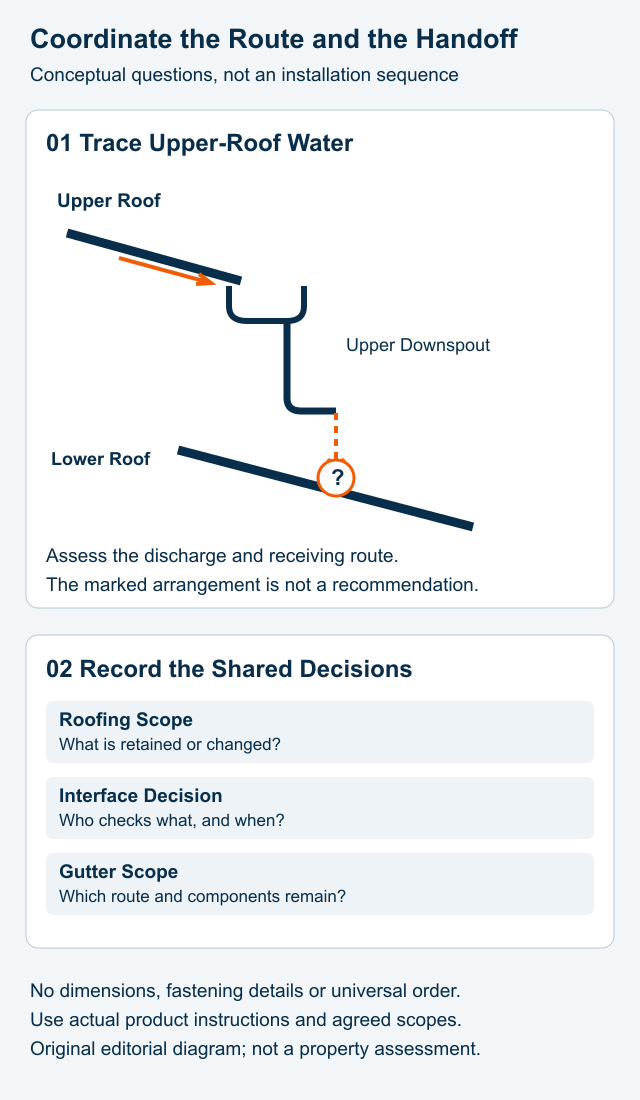
Original conceptual coordination map. The marked discharge is a question to assess, not a recommended arrangement. No dimensions, fastening details, approved route or universal work sequence are shown.
If the proposal changes the roof area feeding a run or its outlets, keep the collection-system questions visible too. The gutter-sizing guide explains why the roof catchment, channel and exits belong in the same conversation.
Include Retained Gutters and Guards in the Plan
“Not being replaced” does not mean “outside every coordination question.” Ask how the work accounts for gutters, guards and downspouts that will remain. Will they stay in place? If temporary removal is proposed, who handles removal, storage, reinstallation and the review afterward? What existing condition is recorded before work begins?
These are questions for the actual scope, not prescribed work methods. If the documents do not state how retained components are handled, request clarification rather than assuming protection, repair or replacement is included.
For guards, identify the product and obtain the applicable instructions. GAF's gutter-cover bulletin discusses roofing-interface considerations and following instructions; it distinguishes its shingle warranty from guard products and installation damage. It does not say that every guard installation voids roof coverage. GAF TAB-R-113: Gutter Covers and Shingles.
The guard-maintenance guide addresses product care and access in more detail. Here, record whether the roof project changes those arrangements and which instructions apply to the proposed work.
Agree What Must Happen Before Each Task
Coordinate decisions as well as dates. The examples below show how to record a handoff; they do not prescribe whether roofing or gutter installation always comes first.
Example 1: Gutters Will Be Retained
The roof proposal says the gutters will remain, but the guard handling is not described. Before relying on that plan, identify the guard product, whether the proposed roof work needs access at its attachment and which scope covers any removal and refitting. Keep the existing-condition record with that decision.
The handoff is a named confirmation point: the responsible provider explains how the retained assembly fits the roof-edge work, and the two scopes reflect that answer. “Roofing complete” should not silently become “guards removed, refitted and reviewed” when those tasks were never included.
Example 2: Removal Exposes an Unresolved Support Condition
The gutter proposal allows for an existing section to be removed, while the condition of the supporting surface remains unknown. Record who will assess the exposed area and who can authorize any proposed additional work. The next dependent task should be discussed against that finding, rather than an assumed repair quantity or an unchanged calendar date.
If the finding changes the work, keep the description, responsible scope and timing implications together in the revised record. That is a project-specific decision point, not a prediction that hidden damage exists. Once these handoffs are understood, the gutter installation preparation guide helps carry the agreed access, product choices and final-review arrangements into the project.
Use a Shared Coordination Record
Open the Roof-and-Gutter Coordination Worksheet, or use the following table during the scope discussion:
| Interface | Record Before Relying on the Schedule |
|---|---|
| Roof edge | Retained/changed detail, applicable instructions and review responsibility |
| Supporting surface | Assessed condition, concealed areas and change-agreement process |
| Roof-wall junction | Affected materials, responsible scope and review point |
| Upper-roof discharge | Intended route, retained connections and unresolved questions |
| Gutters and guards retained | Handling scope, condition record and reinstallation responsibility if applicable |
| Completion | Each scope's final review, documented limits and next contact |
Keep the record with both proposals. When a decision changes, record the changed scope and any timing implications rather than leaving two conflicting versions in circulation. A completed table organizes the discussion; it does not certify an assembly or replace the applicable product instructions.
Clarify What the Final Review Covers
Ask each provider what its final review establishes and what remains outside its scope. Identify the roof-edge and discharge handoffs explicitly so “our portion is finished” does not become an assumed assessment of every adjoining component.
Keep actual product and workmanship terms with the relevant scope. GAF's runoff bulletin, for example, distinguishes shingle manufacturing coverage from damage attributable to concentrated discharge and from gutter-system design or performance. That distinction is a reason to obtain the applicable terms, not a warranty interpretation for your home.
Discuss the Gutter Portion of Your Project
For gutter installation and replacement, bring the roof-work scope, the keep/change list and any unresolved interface questions. If the issue is a focused existing concern, the repair-or-replace guide can help frame the comparison.
Contact Atlanta Gutter Specialist to discuss the gutter portion of your project. Confirm any separate roofing, wall or supporting-surface work with the responsible provider.
Sources and Method
Research checked October 26, 2026. GAF TAB-R-113 carries revision code RI01252021; TAB-R-141 and TAB-R-150 carry RI02012021. PNNL's roof-wall guide was updated September 14, 2020. These sources support the interface questions, not a universal sequence, current Atlanta code determination or property-specific warranty conclusion. The diagram, scenarios and coordination record are original explanatory tools.