
This guide focuses on how existing and proposed materials work together. It does not rank copper against aluminum, prescribe a coating or predict when a component will fail.
For the separate buying decision, the copper-versus-aluminum comparison explains material labels, finishes and joint specifications. This guide focuses on what happens where known materials and runoff routes meet.
Two Different Paths Deserve Attention
AMPP's technical explanation distinguishes direct copper-to-aluminum contact in the presence of moisture from aluminum exposed to copper-containing runoff. The first concerns a metal-to-metal relationship; the second can involve a water route even where the original components are not touching. AMPP: Galvanic and Deposition Corrosion.
For a homeowner, these are two separate questions to put on the assessment record:
| Path to Consider | What to Ask |
|---|---|
| Direct contact | Which metals meet at the joint, attachment or adjoining detail, and how is compatibility addressed? |
| Runoff | Which materials does water pass over before reaching this gutter or component? |
A gap between two visible pieces does not answer every runoff question. Likewise, identifying copper somewhere on the home does not establish that a particular aluminum component is exposed to it. The route and actual assembly matter.
Ask the assessor to explain which path is relevant, what evidence supports that explanation and which parts remain unverified. A general warning about “mixed metals” is not yet a scope of work.
Identify Materials Before Comparing Colors
Begin with product records, the existing proposal and safely available information. Ask what is known about the gutter, roof details, flashing, downspouts, connecting pieces and attachments. Where identification is uncertain, record it as uncertain rather than assigning a metal from color alone.
A painted finish can make components look alike without establishing that the underlying materials or connections are suitable together. Ask for the proposed product information and an explanation of how it fits the retained components. A color sample answers an appearance question; it is not an assembly compatibility assessment.
Do not scratch a finish, remove a fastener or take apart a joint to identify materials for this guide. Ask how the relevant information can be established as part of an appropriate assessment. Keep any inaccessible or concealed condition visible on the record.
Trace What Is Upstream of the Gutter
If a proposal involves aluminum near copper roof details, ask where runoff travels. Which roof or flashing surfaces feed the run? Does the proposed work change that path? Which component receives the water next?
The AMPP article explains that runoff from copper architectural elements can carry a corrosion concern to aluminum components. Its examples and tests illustrate a mechanism; they do not supply a failure timeline or prove the cause of marks at your home. Use the source to frame the route question, not to diagnose a photograph.
A simple annotated sketch can separate confirmed connections from assumptions. Label the materials that are actually known and draw only the route that has been established. If water disappears behind a cover or enters an unidentified connection, mark that part unknown.
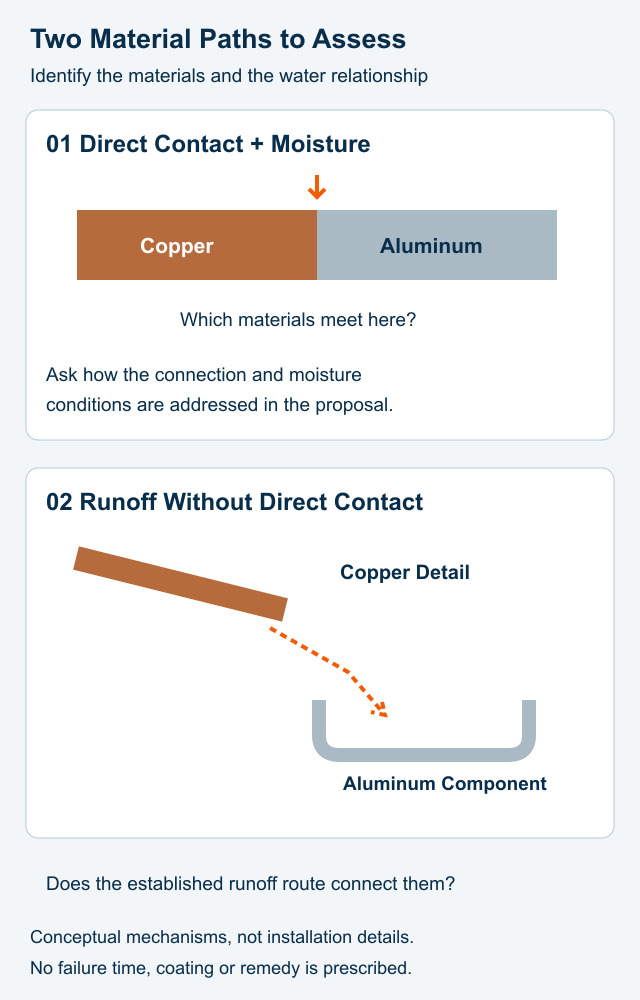
Original mechanism map, not a construction detail or a diagnosis. Arrows identify relationships to assess; no coating, separation distance, material substitution or failure time is recommended.
The downspout route guide follows the larger receiving-route question. Here, the additional issue is which materials that water meets along the way.
Ask About Copper-Containing Shingle Granules
Copper roof sheet or flashing is not the only context discussed in technical guidance. GAF has a bulletin about aluminum gutters and flashings in relation to copper granules used in algae-resistant shingles. The bulletin reports limited manufacturer experience, describes drainage and accumulation conditions, and explicitly avoids predicting whether problems will occur. GAF TAB-R-107: Aluminum Gutters and Copper Granules.
Do not turn that into “algae-resistant shingles always destroy aluminum gutters.” Nor should a general reassurance replace an assessment of an actual concern. Ask which roof product is present, what was found in the affected area and how drainage and accumulation were evaluated.
Use the applicable roof-product information when discussing the finding; a shingle category alone does not establish that a gutter needs replacement.
Ask About the Whole Connection
A replacement proposal needs to explain more than the visible length of gutter. Ask which adjoining pieces, attachments and retained components form the connection, and what product or assembly information supports the proposed combination.
Useful questions include:
- Which materials are confirmed, and which are assumed?
- Where do those materials meet or share a runoff path?
- Which existing parts are retained?
- What instructions or technical information apply to the proposed connection?
- Who will clarify an unidentified component before relying on it?
Do not infer that a particular fastener, sealant or painted finish is suitable because it is common or matches the color. Ask for the basis of the proposed detail. This guide does not provide a compatible-fastener chart or authorize a field-made separation method.
Do Not Treat a Coating as a Universal Answer
If someone proposes a coating or barrier, ask which product or assembly instruction supports that approach for the actual condition. Clarify what it is intended to address, how it relates to the contact and runoff questions, and what limitations or ongoing care apply.
A statement that “it is coated” leaves important information unresolved. Which surface is protected? What is known about the existing finish? Does the proposed work also account for runoff? Do not apply a product yourself on the strength of this article or assume that one treatment is suitable for every combination.
The practical goal is a documented rationale, not a general promise that a layer of paint makes all materials compatible. Record any concealed condition that has not been assessed.
Separate a Visible Mark From a Confirmed Cause
Record where discoloration, surface change or a leak appears, without labeling it corrosion solely from appearance. Ask what assessment supports the explanation and whether the material and water route were established.
For example, “a mark is visible near this connection” is an observation. “Copper runoff caused this failure” is a conclusion that needs evidence. A useful proposal should explain that difference and identify any uncertainty that affects the recommended work.
A leak can also raise connection, support or water-path questions that this materials guide does not settle. The overflow guide and water-behind-the-gutter guide help describe those other paths without assuming a cause.
Compare the Parts Retained as Carefully as the New Parts
When one section is being replaced, ask how the new work will connect with what remains. Does the proposal retain an outlet, downspout, fitting or roof detail that needs a separate compatibility question? If the recommendation changes a route or component, ask which finding explains the change.
A proposal for the same material throughout and a proposal that retains mixed components are not identical scopes. Neither should be selected from a general article alone. Compare the stated basis, instructions, retained parts and limits.
The repair-or-replace guide helps compare the extent of work without imposing an age or price threshold. The roof-and-gutter coordination guide can help record who addresses a roof-edge interface when more than one scope is involved.
Record the Materials, Connections and Runoff Route
Open the Compatibility Worksheet, or record these items during the discussion:
| Item | What to Record |
|---|---|
| Affected location | Which run, connection or roof detail is involved? |
| Materials | Confirmed product information and unidentified components |
| Direct contact | Which pieces meet and what is proposed at that interface? |
| Runoff | Known upstream materials and receiving components |
| Conditions assessed | Actual findings and anything concealed or inaccessible |
| Proposed work | Parts changed, retained and excluded |
| Technical basis | Applicable product or assembly information |
| Remaining question | Who will clarify it and before which decision? |
Keep observations, proposed work and completed work separate. A finished worksheet is not a corrosion test or a compatibility certificate. Its value is making the scope easier to understand and the remaining questions harder to overlook.
Questions Homeowners Often Ask
Must Every Aluminum Gutter Near Copper Be Replaced?
That conclusion does not follow from this guide. Establish the materials, contact or runoff relationship and actual condition first. Ask what evidence supports the proposed extent of work.
Does Matching Paint Mean the Parts Are Compatible?
Matching appearance does not establish the underlying material or the suitability of the connection. Request the relevant product and assembly information rather than relying on color alone.
Can I Tell the Cause From a Photograph?
A photograph can locate a visible concern, but it may not establish materials, concealed contact or the upstream water route. Keep what the image shows separate from the explanation still needing assessment.
Discuss Your Existing Materials
For gutter installation and replacement or gutter repair, bring the material records you have and the location of the concern. Contact Atlanta Gutter Specialist to discuss how the existing components affect the gutter portion of your project.
Confirm which components and tasks the proposed scope includes.
Sources and Method
Research checked October 26, 2026. AMPP identifies original publication in September 2023; its web address contains a May 2024 repost date. GAF TAB-R-107 carries revision code RI02012021. The questions and diagram are original explanatory tools, not a product test, failure prediction or property diagnosis.