
A material comparison becomes misleading when one option includes a continuous run, new outlets and downspouts while the other covers only replacement channel sections. The totals may differ because the jobs differ. A useful comparison separates those choices instead of attributing every difference to aluminum or vinyl.
Start With Two Product Descriptions You Can Read
A complete description identifies the product or fabrication arrangement, profile, dimensions and finish. It also states which runs and components are included. A familiar color or a photograph of the front face cannot supply all that information.
Manufacturer documents provide concrete examples. Englert's seamless-gutter catalog describes aluminum gutter components. Amerimax's traditional vinyl instructions show a different component arrangement, including joiners and hooks. These are examples of specified systems, not products promised by Atlanta Gutter Specialist.
A quotation that names only “aluminum” or “vinyl” leaves too much unresolved for a fair comparison. Add the actual product information first. Then separate what is being purchased from what is being retained.
Material and Profile Are Different Choices
A material label does not establish the channel's exact shape or dimensions. Two products can have similar front faces but different connections, supports or outlets. The comparison needs their actual drawings and component information, not just a shared size label.
ATAS rainware information separates profile families, product dimensions and downspout forms. It illustrates why an assembly description contains more than the material name.
This matters when appearance is important. A homeowner may want the new gutter to resemble the old roof edge while changing the construction or downspouts. “Match existing” should identify the attribute being matched: visible profile, color, material, dimensions or route.
Our gutter types guide explains those attributes in more detail. This comparison focuses on what changes when actual aluminum and vinyl assemblies are proposed for the same project.
Compare the Channel and Its Connecting Pieces
A formed metal run and a component-based vinyl assembly are concrete examples of different construction. New Tech Machinery's MACH II description identifies coil being formed into a continuous gutter length. The Amerimax document instead identifies supplied vinyl lengths and separate joiners.
| Assembly Detail | Continuous Metal-Run Example | Amerimax Traditional Vinyl Example |
|---|---|---|
| Straight channel | Formed length for the run | Supplied lengths connected by joiners |
| Connections to identify | Ends, corners and outlets | Joiners plus ends, corners and drop outlets |
| Support information | Applicable arrangement for the specified metal run | Product-specific hook arrangements |
The comparison is useful because a replacement description must identify different pieces. It does not mean every aluminum gutter is continuous or every vinyl system uses the Amerimax connector. Material and construction have changed together in these examples; do not treat them as an isolated material test.
A new channel meeting an existing downspout creates another boundary. Similar nominal size does not identify the connector or establish the retained component's suitability. Our seamless-versus-sectional guide develops that construction question separately.
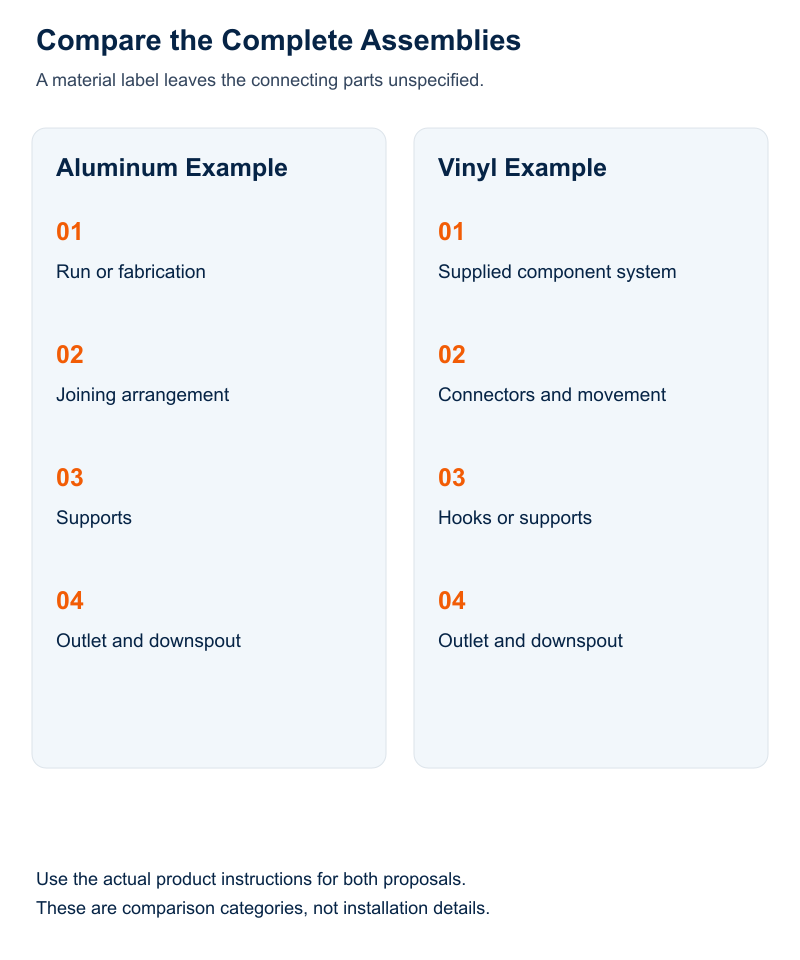
The diagram organizes channel construction, connections, supports and outlets into comparison categories. It shows comparison categories, not clearances or fastening details.
Understand Why Movement Instructions Change the Assembly
The Amerimax instructions describe temperature marks at a drop outlet and an alternative arrangement that lets a gutter end move for expansion and contraction. Those are not decorative markings: they identify how that particular connection is intended to work.
For the homeowner, the important distinction is between a connection assembled according to its own instructions and one improvised to look similar. A connector, hook and outlet cannot be reduced to generic interchangeable accessories. No dimension, gap or fastening method from that document should be copied to another system.
A metal proposal also needs its applicable support and connection arrangement. The useful comparison is not “vinyl moves, aluminum does not.” It is whether each assembly explains the movement-related details its own instructions require, including boundaries with retained parts. The material name alone does not supply those details.
Evaluate Supports and Adjoining Surfaces Separately
The gutter body, its supports and the surface receiving those supports are related but distinct. Replacing the channel does not establish the condition of concealed material behind it.
A proposal can identify visible findings and limits before removal. It can also describe how newly exposed conditions will be communicated before additional work is agreed. Neither approach requires pretending that hidden surfaces are already known.
This is where a broad claim that one material is “stronger” can distract from the actual project. The selected product's dimensions, components and support arrangement need a basis. A universal ranking of material families would not explain whether the proposed work addresses the conditions at your home.
Do not climb, dismantle a connection or remove a guard to investigate. Use existing records and safely available ground-level photographs to identify the area and explain what cannot be seen.
Compare the Same Water Route
The gutter material does not independently establish how much water the complete system can handle. The contributing roof areas, profile, outlets and downspouts remain separate considerations.
PNNL's gutter and downspout guidance treats roof-water collection and onward discharge together. A retained downspout or concealed receiving pipe should not silently become an assessed part of the new installation.
For example, one proposal might replace the rear gutter but retain the existing downspout; another might include a new outlet and rerouted downspout. The difference in onward work needs to be visible before the material prices are compared.
If sizing is the unresolved question, read five-inch vs. six-inch gutters. Neither aluminum nor vinyl supplies an Atlanta-wide sizing answer.
Work Through a Hypothetical Comparison
Suppose Proposal A identifies an aluminum run, new outlet and new downspout. Proposal B identifies a vinyl component system but retains the current outlet route. These are hypothetical descriptions, not company offers or customer estimates.
First, list the included roof edges. If both cover the same locations, compare the component work next. Proposal A changes more of the route. That does not prove it is the better choice; it explains why the two descriptions cannot yet be treated as equivalent material options.
Now add the access arrangements. One proposal includes removing and refitting existing guards, while the other has not addressed them. This is another scope difference. Record it separately so a missing access item is not mistaken for a material saving.
Finally, consider a requested color match. One description names a finish and sample; the other says only “white.” The homeowner can resolve the appearance choice without assuming that color proves matching substrate, connectors or care requirements.
Use an Assembly Comparison Record
Enter information from the actual documents. “Not confirmed” is a useful answer when it identifies the next decision.
| Comparison Field | Aluminum Proposal | Vinyl Proposal |
|---|---|---|
| Named product or fabrication arrangement | Record the specification | Record the specification |
| Profile, dimensions and finish reference | Identify the drawing and sample | Identify the drawing and sample |
| Included roof edges and runs | List locations | List locations |
| Sections, joints, corners and outlets | Record the arrangement | Record the arrangement |
| Supports and movement details | Identify applicable instructions | Identify applicable instructions |
| Retained parts and connection boundaries | Separate assessed from unknown | Separate assessed from unknown |
| Access, removal and refitting work | Record responsibility | Record responsibility |
| Care information and exclusions | Keep the relevant documents | Keep the relevant documents |
This original record compares a whole job rather than scoring an entire material family. For broader inclusions and exclusions, use the installation estimate guide.
Questions About Aluminum and Vinyl Gutters
Is Aluminum Automatically Better Than Vinyl?
A material label alone does not decide suitability. Compare the specified products, roof-water route, support arrangement, connections and work included for your home.
Do All Vinyl Gutters Use the Same Connectors?
No universal connector arrangement should be inferred from the category. Use the documents for the actual product; the Amerimax example describes one particular system.
Can Existing Downspouts Stay With a Different Gutter Material?
Retention needs a project-specific basis. Identify the actual materials, connection arrangement, condition and capacity questions instead of assuming that a similar size or color establishes compatibility.
Can I Choose by the Lowest Total?
Compare what the totals include first. Different roof edges, outlets, downspouts, guard access or related work can explain a price difference without establishing a universal material advantage.
Choose the Work Your Home Needs
For gutter installation and replacement, begin with the roof edges involved, the existing parts you hope to retain and the information supplied with each proposal. Keep material choice connected to the complete assembly.
Contact Atlanta Gutter Specialist about your project and the options you want to compare.
Sources and Method
The cited manufacturer documents illustrate their own assemblies, not current company inventory or comparative testing. Their issue dates were not established; the Amerimax document is manufacturer-authored and retailer-hosted. PNNL lists September 26, 2021 as its last update. Checked October 26, 2026. The hypothetical comparison, worksheet and diagram concept are original editorial aids.