
Start with the location: over the front edge, behind the gutter, at a joint or near a downspout. These observations help focus an assessment without assuming the whole system needs replacing.
First, Separate Overflow From Other Water Paths
“Overflowing” can describe several different observations. Before choosing a remedy, describe the location as precisely as you can.
| What you notice | What to ask about | What it does not prove |
|---|---|---|
| Water crosses the front edge along a run | Was the outlet/downspout checked, and does the run drain toward it? | That the gutter is too small |
| Water spills at one inside corner or below a roof valley | How much roof area feeds that point, and how is the concentrated flow collected? | That one accessory will solve the problem |
| Water appears between the gutter and fascia | Is roof-edge water being directed into the gutter? | That flashing is definitely missing or concealed wood is rotten |
| A joint drips while water stays within the gutter | Is this a localized connection issue rather than a front-edge spill? | That the whole run needs replacement |
| Water emerges around a downspout or underground connection | What is the condition and destination of the connected route? | That visible yard pooling necessarily causes roof-level overflow |
Use these as questions, not a diagnosis. A safe ground-level view can help locate a symptom, but it cannot reveal every condition inside a gutter, behind trim or underground.
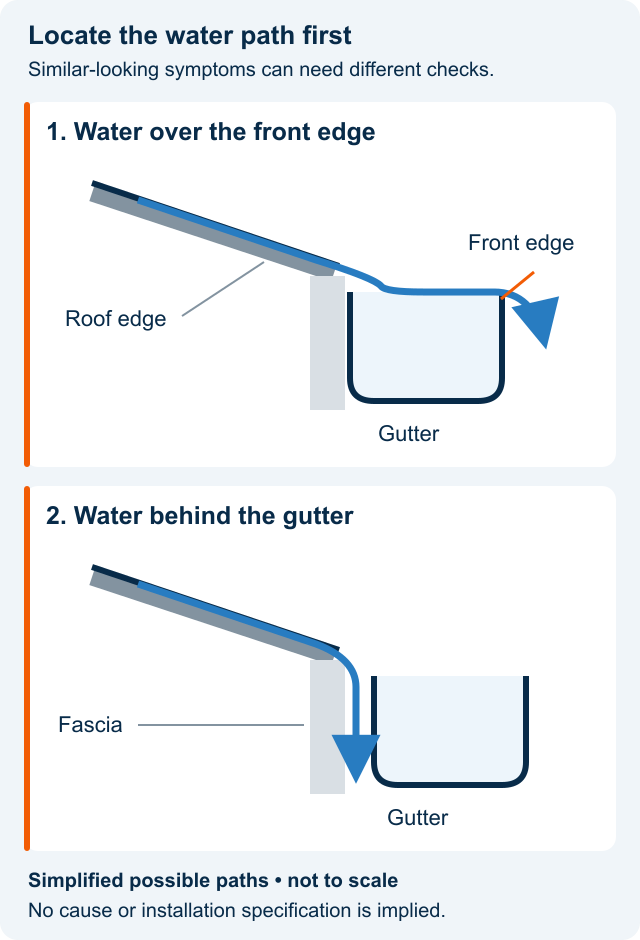
Simplified possible water paths. The drawings distinguish observations; they do not identify a cause or prescribe an installation detail.
Check What the Cleaning Included
If water spilled again after a recent visit, ask which parts were included in the work and what was observed afterward. “Gutters cleaned” and “the complete connected drainage route checked” are different descriptions of scope.
Useful questions include:
- Were only the open gutter runs cleared, or were the outlets and downspouts also checked?
- Were any elbows, screens or connections identified as restricted or damaged?
- Does a downspout connect to a buried pipe, and was that pipe included in the visit?
- Were remaining concerns recorded, such as a low section, loose support or inaccessible outlet?
A restriction is a possibility to investigate, not evidence that the previous cleaner did poor work. Portland's municipal maintenance guidance, for example, identifies downspout elbows and underground standpipes as separate places to inspect for clogs. Its local disconnection rules are not Atlanta rules. Portland stormwater maintenance guidance.
Five Explanations Worth Investigating
1. The Water Route Has a Restriction Beyond the Visible Gutter
A clear trough does not establish the condition of a connected downspout or buried line. Ask the assessor to distinguish a restriction from a disconnected section, damaged connection or an unknown destination.
Where the route disappears underground, “it goes into a pipe” is not a complete answer. What does that pipe connect to? Where does it release water? Which parts were actually inspected? The explanation should identify what is known and what still needs investigation.
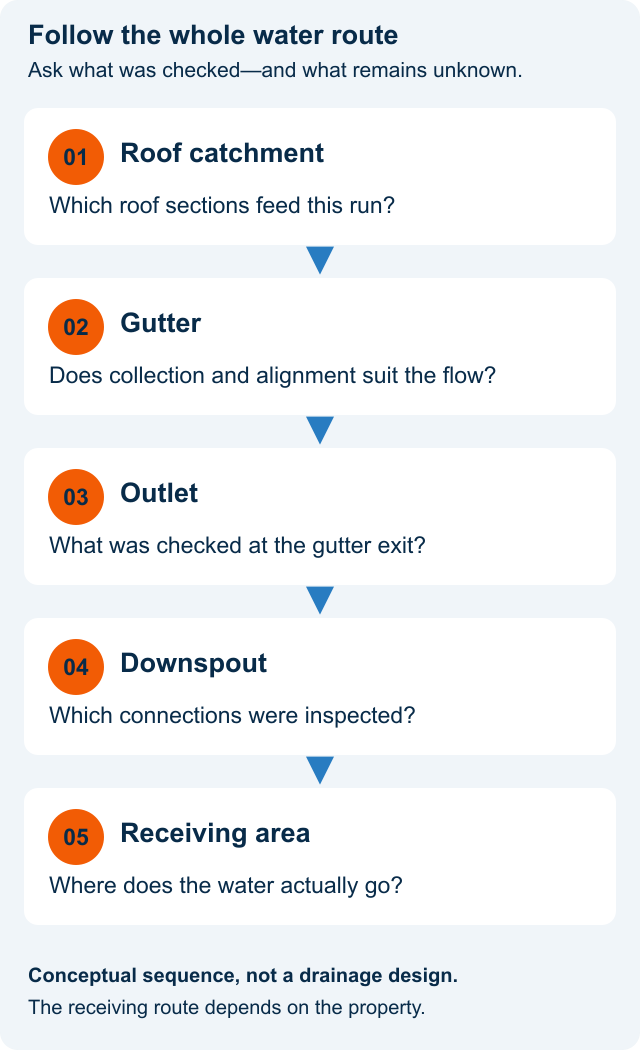
Follow each stage of the route. The receiving area depends on the property; a buried drain is not assumed or shown as a universal solution.
2. The Gutter, Outlet and Downspout Are Not Working as a Matched System
A recommendation should consider more than the width of the gutter. The USDA Natural Resources Conservation Service's PA-1 design guide pairs gutter capacity with outlet/downspout discharge. Its regional rainfall assumptions are not an Atlanta sizing chart, but the method illustrates why the components must be considered together. NRCS gutter and downspout design guide.
If a proposal recommends larger gutters, ask:
- Which roof sections feed the affected run?
- What is changing at the outlets and downspouts?
- How does the proposed route address the location where water currently escapes?
- What evidence separates a capacity concern from a restriction or collection problem?
Spilling only during intense rain is useful context, but it does not prove a size problem. Do not treat a citywide annual rainfall average as a sizing answer. NOAA's precipitation-frequency information distinguishes location, duration and frequency; a design recommendation needs the appropriate inputs and method. NOAA Precipitation Frequency Data Server.
3. A Run Is Not Directing Water Toward Its Outlet
Cleaning removes material; it does not change a gutter's position. A low or sagging section deserves an assessment of alignment and support, rather than an automatic assumption that another cleaning will correct it. Municipal maintenance guidance separately addresses gutter fall and low or sagging areas. Portland's gutter maintenance section.
Ask what was measured or inspected. “It looks low from the driveway” is a useful observation to report, but a ground-level photograph does not establish the slope of the run. Likewise, remaining water is not enough on its own to decide between adjustment, component repair and replacement.
4. One Roof Junction Sends Concentrated Flow to a Small Collection Area
A problem at a valley or roof-wall junction may need a closer look at where the runoff originates. The Georgia Rainwater Harvesting Guidelines explain that valleys combine runoff from two roof planes and that capture at that point depends on roof area, slope and rainfall intensity. This historical guide is useful for that physical principle; it explicitly is not code and should not supply current Atlanta requirements. Georgia Rainwater Harvesting Guidelines, printed page34.
For a spill at one corner, ask whether the assessment traced the roof areas above it. A proposed splash-control detail should come with an explanation of the water path it addresses, rather than a promise that the same accessory fixes every corner.
At a roof-wall intersection, flashing is part of that conversation. PNNL explains how kick-out flashing directs roof-wall runoff into the gutter and must work with the surrounding water-control layers. PNNL roof-wall flashing guide.
5. Water Is Passing Behind the Gutter
Water between the gutter and fascia is a different observation from water spilling over the front. The roof-edge relationship deserves attention before assuming that debris or gutter size is the cause.
GAF's drip-edge bulletin describes how this flashing directs water away from the roof edge and how the shingle/gutter relationship helps guide it into the gutter. The details are manufacturer-specific, not a universal repair instruction. GAF drip-edge technical bulletin.
Ask whether the proposed work addresses the roof edge, the gutter or both, and who will evaluate any concealed condition. A stain alone does not establish missing flashing, rot or responsibility for the problem.
Do Not Stop at the Bottom of the Downspout
Even when collection at the roof edge works, the receiving area still matters. DOE/PNNL treats gutters, downspouts and site drainage as a connected water-management system intended to move runoff away from the home. It also distinguishes gutter conveyance from perforated foundation drainage. PNNL gutters and downspouts guide.
For your assessment, ask where the water ends up and whether the proposal creates a new concern near the home, a walkway or another property. Do not assume that reconnecting, extending or redirecting a pipe is suitable without checking the site and applicable requirements.
Pooling at ground level and spilling at the gutter may be separate problems. Describe both; let the assessment establish whether they are connected.
Should the Next Step Be Cleaning, Repair or Replacement?
Start with the explanation of the problem, then compare the proposed work with that explanation.
- If a restriction is identified: ask what will be cleared, which connected sections are included and what will remain unverified.
- If a component or support concern is identified: ask which parts are affected and how the proposed repair addresses them.
- If the assessment identifies a wider collection or layout concern: ask why the proposed change is needed and how the outlets, downspouts and receiving route fit the recommendation.
These are decision questions, not rules that determine the right service for every home. A useful proposal makes the connection between the finding and the work understandable.
Explore gutter repair for a focused concern, gutter installation and replacement when a wider change is being considered, or gutter cleaning when maintenance is the issue.
Record Where and When the Water Escapes
You do not need to climb a ladder or reproduce the problem to describe it. Use what you can safely observe from the ground or a sheltered position. Stay away from overhead wires, unstable components and unsafe weather; CPSC specifically warns about electrical hazards when ladders are used for gutter and other exterior work. CPSC ladder and electricity warning.
Record these details:
| Detail | What to write down |
|---|---|
| Location | Which wall, corner or downspout is involved? |
| Water path | Over the front, behind the gutter, at a joint or near a connection? |
| Timing | What rain conditions did you notice? Did it continue afterward? |
| Recent work | What was cleaned or repaired, and when? |
| Known route | Where does the downspout visibly lead? Mark anything unknown. |
| Changes | Is this new, recurring or different from before? |
A useful description might be: “Water crosses the front edge at the rear-left corner during heavier rain. The gutters were cleaned last month, but I do not know whether the downspout or connected drain was checked.”
For photos, a wider view can locate the affected run and a closer ground-level view can show the visible symptom. Keep a separate note of anything outside the frame or hidden from view. Photos can support a conversation; they do not replace an assessment.
Questions to Ask Before Agreeing to More Work
- What was found, and which part of the water route was checked?
- What remains unknown or outside the proposed scope?
- How does the proposed work address the specific place water escapes?
- Are roof-edge or underground-drainage questions separate from the gutter work?
- What will the final review establish, and what limitations remain?
If your gutters still spill after cleaning, contact Atlanta Gutter Specialist with the location and what you have noticed. Start with the symptom; you do not need to decide on a repair or replacement before the conversation.