
Compare the evidence behind each recommendation: where the problem occurs, what has already been tried, which components remain suitable, and what the new scope will change. A targeted repair, replacement of one component, and broader replacement are different options to ask about—not a choice that can be made reliably from one photograph.
Start With the Concern, Then Map Its Extent
Write down what you can observe safely from the ground. Identify the affected side of the home, whether the concern appears at a joint or along a run, and whether it happens only in rain. Note previous work and when the symptom returned. These details help frame an assessment; they do not prove the cause.
| What you notice | What the assessment needs to establish |
|---|---|
| A drip at one joint or corner | Is the defect confined to that connection, and what condition are the adjoining parts in? |
| A low or separated section | What is happening to the gutter, its attachments and the surfaces supporting it? |
| Similar concerns in several places | Are they separate defects, or do they share a cause that the proposal must address? |
| Water appearing behind the gutter | Is water entering the gutter correctly at the roof edge? |
| Trouble after an addition or roof change | Does the existing collection and outlet arrangement still suit the roof? |
The City of Portland's maintenance guidance includes checking gutter fall, joints, sagging areas, downspout bends and connected pipes. These are useful assessment categories. Its local maintenance rules, distances and repair instructions are not specifications for an Atlanta home. Portland gutter and downspout maintenance guidance.
Ask for a simple marked photograph or sketch showing the areas assessed and the areas included in the proposal. If the recommendation covers the entire home, the explanation should distinguish what was found at each area rather than treating one visible problem as proof about every run.
Separate the Symptom From the Proposed Solution
A proposal should explain what the work is intended to change. “Stop the leak” describes a goal. It does not tell you whether the work addresses a connection, an attachment issue, the water route or another condition.
For recurring concerns, collect the earlier scope if it is available. Was the same joint repaired? Was an adjacent section replaced? Were the downspout or supporting surfaces examined? “It has been repaired before” is a starting point for questions, not automatic evidence that the whole system must go.
PNNL's Building America guidance treats gutters, downspouts and the route away from the home as parts of water management. That wider view is useful when comparing proposals: work at the roof edge should be considered alongside where the collected water goes next. This guide does not apply the source's federal program requirements or distances as current Atlanta rules. PNNL gutters and downspouts guide.
Ask these questions before comparing totals:
- What observed condition is this work intended to address?
- What evidence supports that explanation?
- Which related components were assessed, and which were not accessible?
- What would remain unresolved after this scope is completed?
If the main problem is overflow after cleaning, use the overflow troubleshooting guide for a closer look at the observations to discuss. This article focuses on comparing the resulting work recommendations.
Check What Will Support the Work
Ask how the condition of the attachment points and supporting roof-edge surfaces affects the recommendation. A proposal that changes the gutter should also state whether any support or fascia preparation is included, excluded or still unknown.
Concealed conditions deserve a clear process rather than an assumption. Ask what can be assessed before work, what may become visible only after removal, and how any additional scope and price will be explained and approved. Do not read “new gutters” as confirmation that every related roof-edge condition is included.
Water entry at the roof edge is a separate question from the condition of the channel. GAF's drip-edge bulletin explains the role of the roof-edge detail in directing water toward the gutter rather than down the building face. That supports asking about the interface; it does not diagnose concealed damage or supply a universal repair detail for every roof. GAF drip-edge guidance, TAB-R-141.
Ask Which Existing Components Can Remain
The comparison need not be limited to “patch everything” or “replace everything.” Ask whether replacing one section, outlet, downspout or other component is an available and suitable option. Suitability and the company's offered scope must be confirmed for the actual property.
For anything retained, ask how its condition, profile and connections were assessed. For anything added, ask how it will fit the remaining system. A matching color alone does not explain the connection detail or material compatibility.
AMPP's technical explanation distinguishes corrosion involving dissimilar-metal contact from deposition associated with copper-bearing runoff. It provides a reason to ask about the actual materials and water path, not a way to judge remaining gutter life from discoloration alone. AMPP on galvanic and deposition corrosion.
GAF's aluminum-gutter bulletin also discusses drainage, moisture and granule accumulation in qualified manufacturer experience. It does not establish that algae-resistant shingles inevitably damage aluminum gutters or that every such combination requires replacement. GAF corrosion bulletin, TAB-R-107.
The practical question is: what makes the retained and replacement components suitable together, and what evidence supports that conclusion?
When retained and new parts use different materials, review the contact and runoff compatibility questions before comparing the proposed connection.
Reassess the Layout When the Roof or Water Route Has Changed
A porch, addition or other roof change gives you a reason to ask how the current layout was evaluated. A replacement proposal should explain the roof areas served, gutter runs, outlets, downspouts and receiving route. A repair proposal should make clear whether it retains those arrangements.
If one option changes the outlets and another keeps them, the proposals are not equivalent just because both mention gutters. Compare the intended result and included work. For size-specific questions, see what determines the right gutter size; a larger nominal size is not a substitute for explaining the complete arrangement.
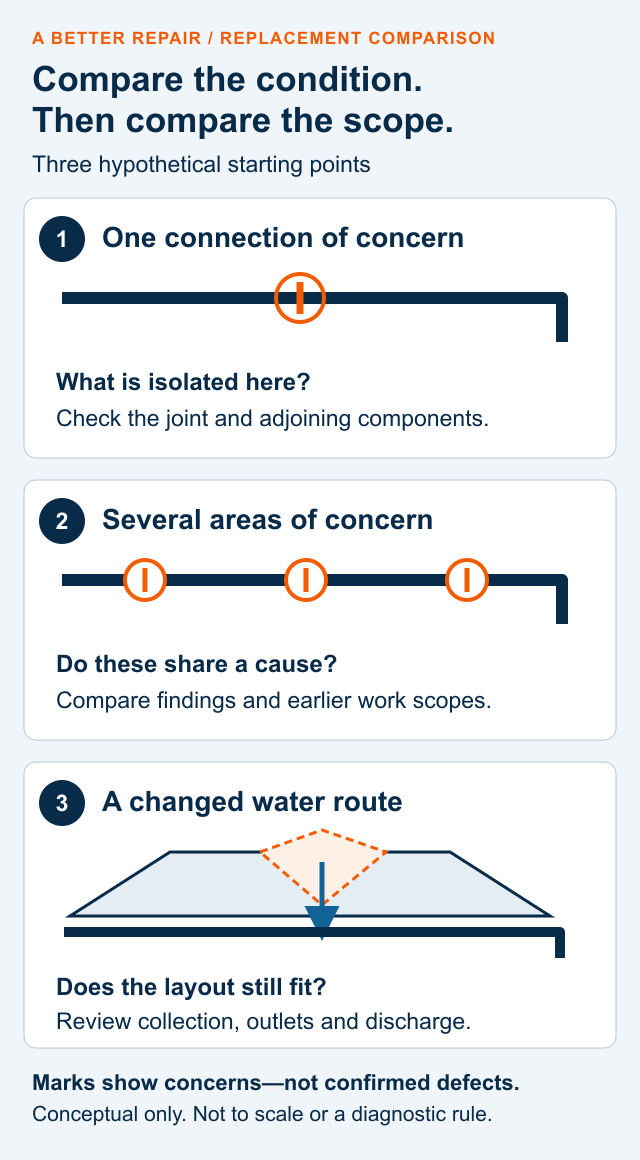
Conceptual examples. Marks identify concerns to investigate; they do not prescribe repair, partial replacement or full replacement.
Three Examples of a Better Comparison
These are hypothetical situations. The outcome depends on findings at the home.
One Leaking Corner
Suppose water drips at one corner and there is no documented assessment of the rest of the run. A useful comparison asks whether the corner can be addressed while retaining suitable adjoining components. If broader replacement is recommended, ask what additional findings explain that scope. The visible drip alone does not answer either question.
Problems Returning in Several Areas
Suppose several locations have received earlier attention and concerns return. Compare the earlier scopes with the new findings. Ask whether the problems share a cause, whether retained parts remain suitable, and what a targeted or broader scope would leave unresolved. Recurrence deserves investigation; this example does not establish a replacement threshold or an economic conclusion.
A Changed Roof Feeding the Existing System
Suppose a new roof section sends water toward an existing run. Compare a proposal that retains the layout with one that revises collection or outlets. Ask each to explain the roof areas served and the route beyond the downspout. The changed roof is a reason to reassess the arrangement, not proof that every existing component must be discarded.
Compare What Each Proposal Includes Before Comparing Prices
The FTC recommends obtaining multiple written estimates that describe the work, materials, completion date and price, and asking for an explanation when estimates differ substantially. This is general consumer guidance, not a technical determination of which gutter option is correct or a statement of Georgia contract requirements. FTC home-improvement guidance.
Use the repair and replacement comparison worksheet to record both proposals. Clarify:
- The assessed areas and documented findings.
- The components repaired, replaced and retained.
- The cause each scope is intended to address.
- Supporting-surface and roof-edge work.
- Outlet, downspout and discharge changes.
- Access, removal, cleanup, final checks and exclusions.
- Unknown conditions and the process for additional work.
A blank is a question to resolve, not confirmation that an item is included. Ask for any applicable product or workmanship terms in writing and clarify which work and retained components they cover. Do not assume that new components extend coverage to the entire existing system.
Questions Homeowners Often Ask
Does Gutter Age Decide Whether Replacement Is Needed?
Age is useful background to share, alongside maintenance and repair history. This guide provides no age-based replacement rule. Ask how the observed condition and proposed scope support the recommendation for your home.
Does One Leaking Seam Mean All the Gutters Need Replacing?
The seam identifies a location to assess. Ask whether the concern is isolated and what findings, if any, support work elsewhere. A photograph of one drip does not document the condition of every gutter run.
Is the Least Expensive Repair Always the Better Choice?
Compare what each option changes and retains before drawing that conclusion. A smaller total may cover less work or leave a concern unresolved; a larger total still needs an explanation. This guide does not estimate costs, savings or remaining service life.
Do I Need to Climb up to Collect Information?
No. Gather notes and photographs only from a safe ground-level position. CPSC warns of electrocution hazards when ladders are used near overhead wires, including during gutter work. Do not climb to complete this worksheet or approach wires to inspect a gutter. CPSC ladder and electricity warning.
Ask What the Proposed Repair or Replacement Would Address
Start with the concern you have noticed, any previous work and the questions you still need answered. Explore gutter repair or gutter installation and replacement, then contact Atlanta Gutter Specialist to discuss your gutters.
You do not need to diagnose the problem before calling. Share where it appears, when it happens and any previous work, then ask which repair or replacement options are worth assessing.
Sources and Editorial Method
Research checked October 24–25, 2026, America/New_York. This guide combines federal and municipal building-maintenance guidance, manufacturer technical bulletins, technical corrosion education and consumer-estimate advice. The comparison questions, diagram, worksheet and hypothetical examples are original editorial analysis; none is a source-issued repair/replacement standard.
GAF bulletins carry revision code RI02012021. AMPP's editor identifies original publication in September 2023; its web address contains a May 2024 repost date. FTC guidance is dated July 2022. Regional rules, numerical installation details and dated injury figures are not applied here.